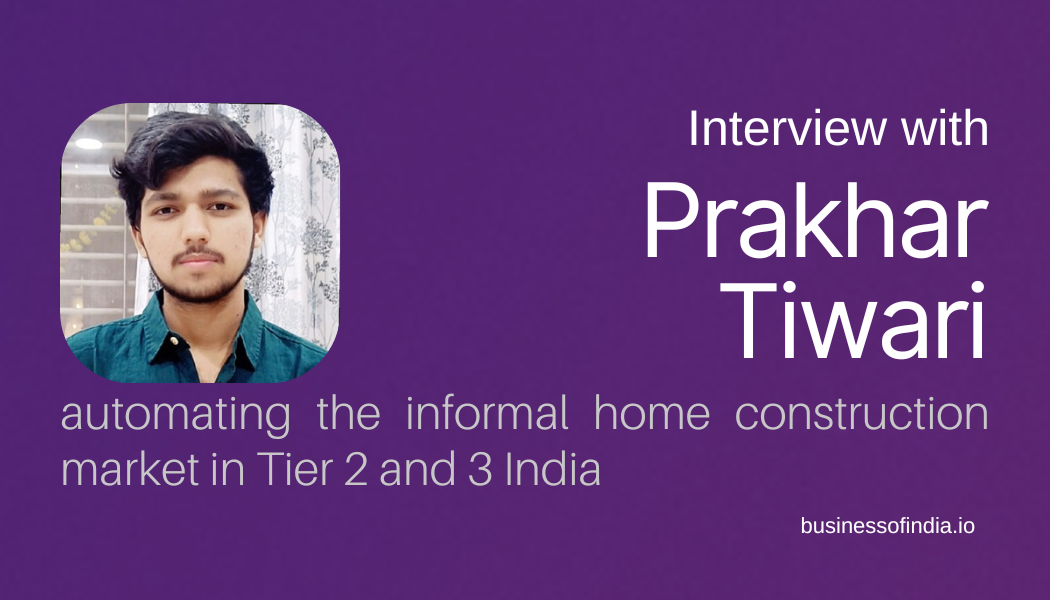
Automating India's informal home construction market with accountability-led infrastructure

In India, 83.4% of total residential construction is built with private capital.
For 9.85 million households surveyed by the National Statistics Office, this percentage represents lifelong savings handed over to contractors on a purely trust-based system. The private construction industry across the country is still largely informal and unorganized, running on word-of mouth referrals, back-of-the napkin maths and verbal contractor commitments.
Prakhar Tiwari is closing that gap with Nesthome, a full-stack tech solution fixing the broken home construction experience by using technology and structure to prioritize transparency.
BOIn: You're currently completing a degree at Amity University in Indore while simultaneously building Nesthome from the ground up, handling product strategy, platform development, and early market validation without a team behind you yet. What made you decide to build something now rather than wait, and what does running a startup while still in university actually feel like day to day?
PT: When I first started college, honestly, I was quite directionless. I was doing my BBA, but I didn't really have a clear purpose or know exactly what I wanted to build my life around.
The interesting thing is that the problem behind Nesthome wasn't completely new to me. My family had personally faced problems during home construction when I was still in high school. At that age, I obviously wasn't thinking about it as a business opportunity, but I had seen how stressful construction could become for a family. There can be uncertainty around contractors, costs, timelines, and what is actually happening with the project. During college, I started looking at this problem much more seriously. I spent a lot of my time doing market research, speaking with people, understanding how the construction industry works and trying to validate whether this was just something my family had experienced or whether it was a much larger problem. The more I researched, the more I realised that it wasn't an isolated experience. A lot of individual homeowners face similar issues. That was probably the point where my thinking changed. Instead of waiting until graduation, getting a job and maybe starting something years later, I thought: if I can see a genuine problem today, why should I wait to start understanding and solving it?
So Nesthome didn't really start with me saying, 'I want to become an entrepreneur.' It started with me becoming obsessed with understanding a problem that I had personally seen. Building it while being in college has also been a completely different education for me. In college, you learn marketing, finance, strategy and management as subjects. With Nesthome, I'm forced to experience those things in reality. One day I'm talking to a potential customer, another day I'm understanding why a lead didn't convert, then I'm sitting with contractors, working on marketing, thinking about the product, or figuring out how we can improve the customer journey. There are definitely days when managing both becomes difficult. But I think starting during college has given me something much more valuable than waiting until I felt completely ready. It gives me time to experiment, make mistakes, understand customers and learn what building a real company actually requires.
BOIn: India's independent home construction market is enormous, with millions of plot owners building their own homes outside of organised developers, often with unverified contractors, no contracts, no timelines, and no recourse when things go wrong. And yet construction-tech in India has historically focused on the developer and commercial side rather than on individual plot owners. Why do you think that segment has been so consistently overlooked, and what does addressing it require that's different from building for developers or real estate companies?
PT: The first thing to understand is that this market is largely unorganised, and when you go into Tier 2 and Tier 3 cities, it becomes even more fragmented. A lot of home construction still happens completely offline. People find contractors through personal references, maybe someone in the family knows a contractor, a neighbour recommends someone, or a friend has recently constructed a house. Personal relationships and local reputation still play a very significant role, but I think there is another reason why this segment has remained overlooked for so long. It's operationally a very difficult business to solve.
This isn't a product where you acquire a customer, complete the transaction and move on. The sales cycle itself can be long. A homeowner may speak with you today, compare different contractors, discuss it with their family, work out their finances and actually start construction months later. Then once you acquire that customer, your responsibility doesn't end there. You're potentially entering into a seven-to-ten-month relationship with that family until their home is completed. So you have complexity on both sides. You have a long customer acquisition and decision cycle on one side, and then a very operationally intensive execution cycle on the other. Every project is also different. The plot is different, requirements are different, budgets are different, contractors are different, and local conditions are different. I think that's one of the major reasons we haven't seen this market become organised as quickly as some other industries.
For developers, technology can primarily be a productivity or management tool. But for an individual homeowner, technology alone isn't enough. You need technology, but you also need operations, quality control, contractor management and accountability on the ground. That's what makes this problem difficult but that's also what makes the opportunity interesting to us. Our view at Nesthome is that we shouldn't try to eliminate the existing offline ecosystem or personal relationships. Instead, we can bring a structured layer around them - verification, agreements, milestone-based payments, transparency and project tracking. So the homeowner can still have that human relationship, but now there is a system creating accountability behind it, and if we can make that work at scale, that's where the real opportunity is.
BOIn: Essentially, you are building the accountability infrastructure for the largely informal layer of the construction industry; the verified contractors, fixed pricing, milestone-based payments, legal agreements, and a mobile app for real-time tracking. Where did you start, what are you still building, and what have you had to consciously leave for later?
PT: When I initially started working on Nesthome, the temptation was definitely there to think about the app, live project tracking and all the technology we could build. However, I realised quite early that if the underlying construction process itself isn't structured, putting an app on top of it doesn't really solve the problem, so we eventually started from the ground level. The first phase for us has really been market research and problem validation. We started with speaking with homeowners, understanding contractors, studying how customers currently choose who builds their house, where trust breaks down, why budgets change, and where communication problems happen, and we're still very early.
Right now, our focus is on building and validating the core operating model, from how we acquire the right customer, to how we qualify them, how the consultation and site visit should happen, how quotations should be structured, how we select execution partners, and eventually how that customer moves from the first conversation to actually starting construction. We are taking our time with this process because, before automating something, I think you first have to understand exactly what you're automating. Then, the second layer is accountability. We're working towards a system where the scope is clearly documented, there are proper agreements, payments are linked to defined construction milestones, and both the homeowner and execution partner understand exactly what is expected from them.
Then comes the technology layer. Our larger vision includes real-time project tracking where homeowners can see progress, milestones, payments, updates and important project information from one place, but we're consciously trying to not build the entire technology stack on day one. At this stage, I'd rather manually understand 20 customers extremely well than build 50 features based on assumptions. There are also things like deeper automation, advanced contractor scoring, data-driven quality monitoring and potentially much more intelligence around construction that we can build later, but those only become valuable once we have enough projects and real data behind them.
So I think our approach has been to first understand the problem, then standardise the process, then use technology to scale that process. We're not trying to look like a mature company before becoming one. We're trying to build the foundations correctly so that when we scale, we're scaling something that actually works.
BOIn: Rather than launching in the metros where construction-tech startups typically try to prove themselves first, you're building specifically for Tier 2 and Tier 3 cities, Indore being your starting point. What does the home construction problem look like differently in Indore or Bhopal compared to Mumbai or Bangalore? What have you discovered about the specific trust dynamics, contractor relationships, and customer behaviour in your market that a Delhi or Bangalore-first company would have missed?
PT: Starting from Indore was quite natural for us because this is the market where we have been able to observe the problem very closely. What I've realised is that in Tier 2 and Tier 3 cities, home construction is still extremely relationship driven. When someone wants to construct their house, their first question is usually not, 'Which construction platform should I use?' Their first instinct is often, 'Do I know someone who knows a good contractor?'
It could be a contractor recommended by a relative, neighbour, architect, friend or someone who has recently constructed their own house. That personal reference carries a huge amount of weight. We've actually seen this ourselves while talking to customers. Sometimes you can provide a competitive quotation, explain the process properly, and build a good relationship with the customer, but, if someone from their trusted circle recommends a contractor they've personally worked with, that recommendation can still become the deciding factor. That taught me something important.
Technology alone isn't going to solve the trust problem in this market. You first have to understand how trust already works.
At the same time, there is a weakness in this reference-based system. Someone being recommended doesn't automatically mean the customer gets proper documentation, transparent pricing, defined timelines, quality checks or accountability throughout the project. That's where I think Nesthome has an opportunity. We don't want to remove the human trust that already exists in these markets. We want to add a professional system around it.
The second thing we've learned is that timing is extremely important. Home construction isn't usually an impulse decision. A customer might genuinely want to build, but the project could start months later or even get postponed because of finances, family decisions or delayed approvals. So when a customer doesn't answer your call today, it doesn't automatically mean they're not interested. That's actually something I had to learn personally. Early on, I sometimes interpreted a customer not picking up the phone as a loss of interest, but after speaking with more customers, I realised that their lives don't revolve around our sales process. They may still be serious about construction but the timing simply isn't right at that moment.
So patience matters, but at the same time, as a company, we need proper follow-up systems so that we're present when the customer's timing becomes right. I think that's one of the biggest things we're learning by starting in Indore. You can't organise this market by simply bringing technology from the outside. You first have to understand the relationships, behaviour and trust structures that already exist, and then build technology and accountability around them.
BOIn: Nesthome was shortlisted for the India Construction Tech Demo Day 2026 by RealtyNXT. Thinking in terms of that recognition, what layer of the solution has the experience exposed to you that you perhaps did not realize before? What does it take to make the problem feel as urgent to an investor or a partner as it feels to a potential homeowner?
PT: Getting shortlisted for the Demo Day was definitely encouraging for us, especially because we're still at a very early stage, but I think the bigger learning for me was actually around how we communicate the problem.
When you speak to a homeowner who has already gone through construction or is currently building, you don't really have to spend much time convincing them that the problem exists. They already understand it. They've experienced things like budget uncertainty, delays, difficulty tracking progress, communication gaps or depending heavily on contractors for information. However, when you're speaking to an investor or a potential partner, the conversation is completely different. They don't just want to know that the problem exists. They want to understand: How large is this problem? Why hasn't somebody solved it already? Why is this the right time to solve it? And most importantly, can this actually become a scalable business despite construction being so operationally intensive?

Essentially, it made me look at Nesthome from a different perspective. Earlier, I was probably much more focused on explaining individual features but I started realising that the bigger story isn't any one of those features. The bigger problem is that independent home construction still lacks a proper accountability infrastructure. A homeowner is potentially putting a very significant amount of their savings into a project that can continue for eight or ten months, involving contractors, labour, materials, architects and multiple payments, and yet much of that relationship can still operate informally. That's the larger problem we're trying to address.
The other learning was around proof. As a founder, it's easy to become convinced about your own idea because you're living with the problem every day, but an investor or partner doesn't have to believe your assumptions. You have to demonstrate them through customer conversations, market validation, actual projects, conversion data and eventually retention, referrals and unit economics. The experience reinforced a very valid point for me; our job right now isn't to make the biggest claims. It's to keep generating evidence. If we can show that homeowners genuinely value transparency and accountability, that they're willing to choose Nesthome because of it, and that we can deliver that experience repeatedly while maintaining healthy economics, then the urgency of the problem becomes much easier for investors and partners to understand.
Being shortlisted was valuable, but the bigger value was learning how to move the Nesthome story from 'this is a big homeowner problem' to 'this can become a scalable system for solving that problem.'
BOIn: The trust gap you're trying to close, between a plot owner and the contractor they're handing their life savings to, is half technology problem and half social issue. Contractor relationships in smaller cities are often built on personal networks, community trust, and local reputation rather than verifiable credentials. How do you actually build a verification and accountability system in that environment without breaking the informal trust structures that people already rely on?
PT: The first thing to note is that we don't want to replace the existing trust system. In Tier 2 and Tier 3 cities, personal references are extremely powerful, and honestly, they exist for a reason. If my relative or neighbour has worked with a contractor and had a good experience, then naturally I will trust that recommendation. The problem is when that personal reference becomes the only form of verification and accountability.
Having someone say, 'I know this contractor, he's good,' doesn't necessarily tell you whether the contractor has the right experience for your specific project, what quality standards will be followed, what materials will be used, whether the timeline will be maintained, or what happens if there is a disagreement six months into construction. Our approach with Nesthome is not to remove personal trust, but to add a professional layer on top of it. Contractor verification for us shouldn't eventually be just Aadhaar verification or a 'verified' badge. We want it to become much deeper. When we work with a contractor, we want to understand their previous projects, years of experience, execution capability, customer feedback, type and size of projects they can handle, and eventually their actual performance on Nesthome projects.
Then accountability starts once the project begins. There should be clarity around the scope of work, material specifications, project timeline, payment milestones and responsibilities of both sides. Instead of major decisions remaining verbal, important commitments should be documented. Payments should ideally be connected to actual progress. If a particular construction milestone is completed, the corresponding payment becomes due. That creates clarity for the homeowner as well as the contractor.
Over time, technology can make this even stronger because every successfully completed project creates data. We can start understanding which contractors consistently deliver on time, where quality issues occur, how customers rate their experience and which contractors are strongest for particular types of projects. Eventually, reputation doesn't disappear, instead it becomes measurable. That's important because we're not trying to create a system that only protects homeowners. Good contractors should benefit as well. If someone consistently delivers good-quality work, communicates properly and completes projects successfully, that track record should help them win more business.
I see Nesthome as combining local human trust with institutional trust.
You can still have the contractor recommended by somebody you know, but now there can also be verification, documentation, milestone-based accountability and a transparent track record behind that relationship. I think that's how you organise this market without destroying what already works.
BOIn: You've framed Nesthome not just as a technology platform but as a system for accountability, quality control, and peace of mind, and you've said you're building for people who are investing everything they have into a single project that may define their family's stability for a generation. What does the future of home construction in India look like to you if platforms like Nesthome actually work at scale, and what does it mean for the millions of families in Tier 2 and Tier 3 cities who currently have no protection when the process goes wrong?
PT: For me, the future is actually very simple: building your own home should not feel like taking a blind risk with your life savings.
Today, especially in Tier 2 and Tier 3 cities, a family may save for 10, 15 or even 20 years before they finally decide to build their house. When they start construction, they're not just investing money. There are years of savings, emotions and expectations attached to that project, but despite the size of that decision, homeowners can still have very limited visibility and control once construction starts.
That's what I would like to see change. If Nesthome works at scale, I want a homeowner to know exactly what they're getting into before construction even begins; what the approximate cost is, what is included, what materials are being committed to, how payments will happen and what the expected timeline looks like. Then once construction starts, they shouldn't have to call someone every second day just to ask, "Site par kya progress hui?" They should be able to see the progress of their home, understand which milestone has been completed, know why a payment is due, and have proper documentation throughout the journey.
That said, I also don't think the future is about removing contractors and replacing everything with technology. Construction will always remain a very human and operational business. What technology can do is create visibility, standardisation and accountability around those human relationships. If we can eventually do that across Tier 2 and Tier 3 India, I think the impact goes beyond Nesthome becoming a large company. It could also help good contractors build stronger reputations because their actual performance becomes measurable. Customers get greater protection, and the overall market gradually becomes more organised.
My long-term vision for Nesthome is that someday, when a family decides to build a house, having real-time visibility should feel completely normal, not like some premium feature, because ultimately, we're not trying to make home construction slightly more convenient. We're trying to make one of the biggest financial and emotional decisions of a family's life more predictable, transparent, and accountable.
If we can achieve that at scale, I think that would be much bigger than simply building another construction company.