What does it take to build a domestic ecosystem for India's honey?
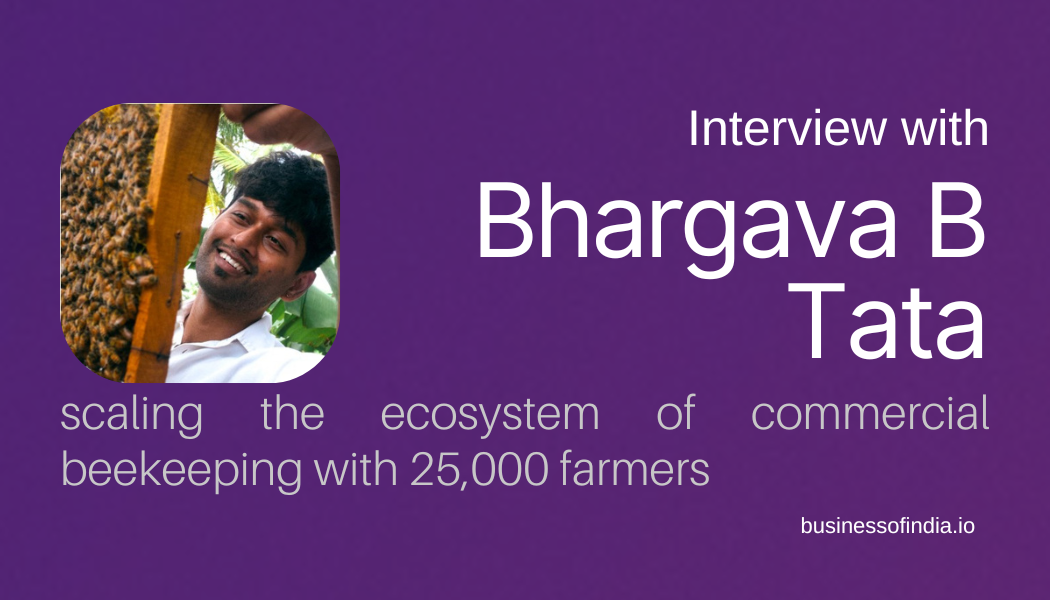
You could wonder how an aircraft maintenance engineer ends up leading growth for a 25,000-farmer-strong beekeeping community.
When HoneyDay Bee Farms started training its first set of beekeepers in 2011, Bhargava B Tata was on his first steps of a different journey. Two years earlier, he had graduated with an A+ in Aircraft Maintenance Engineering from VSM Aerospace, then immediately veered into a series of stints in distribution and retail operations, where he would build a career over the next decade and a half.
By the time Bhargava joined HoneyDay as Chief Business Officer in May 2025, the business had grown from a simple community with a handful of farmers into a full apiculture ecosystem, processing over 150 tonnes of honey per month.
He now leads the mission to 10x revenue growth and scale the business into new B2B markets, expanding HoneyDay's presence in India's 151,000 tonnes per year honey market.
BOIn: You trained as an Aircraft Maintenance Engineer (AME) before your career took you into footwear distribution, e-commerce for watches, rural retail technology at StoreKing, healthcare distribution at Mojocare, EdTech operations at LEAD School, and now beekeeping and apiculture at HoneyDay. That's about as far from aerospace as a career can wander.
What happened in those early years that pulled you away from engineering and into sales, distribution, and B2B partnerships? Do you ever find the aerospace training showing up in how you think, even now?
BBT: Growing up in a small town, my information sources were very limited: newspaper classifieds, the odd brochure pinned to a college notice board. That's how I first found out about Aircraft Maintenance Engineering. But beyond the access, the real pull was how fascinated I was by aircrafts, by what it means to keep something that complex flying. I also knew that I didn't want to do software, which felt like the only default option after engineering, or the self-employed professions like medicine or law. AME felt like the road less taken, so I took it.
I never actually got to work as an AME. Before that chapter opened, my uncle presented me with an opportunity in the family business. In hindsight, it was a decision made in haste. I was young, it was family, so it felt like the right move. But I'd be lying if I said there wasn't a sense of loss. I had genuinely dreamt of a career in aviation, and stepping away from that before it even began left something unresolved in me.
What I carried forward, though, is harder to see but very present. Aviation maintenance is a discipline built on zero tolerance for error. You don't do a half-decent check and move on. There's a standard, and if you don't meet it, something breaks at altitude. That instinct for attention to detail, for not settling for mediocre work, for treating cleanliness and process as non-negotiable - those things have followed me across every sector I've worked in. In a food business like HoneyDay especially, the hygiene standards aren't just operational but also ethical. If anything, AME training gave me a baseline for what "good" looks like that I don't think I could have developed anywhere else.
BOIn: Speaking of HoneyDay, I want to talk a bit about the journey behind the brand. It was initially a beekeeping community founded in 2011 to train farmers and later evolved into a full-stack ecosystem, covering everything from bee breeding to honey bottling. Recently, you joined as a founding team member focused on B2B sales, contract manufacturing, and private labelling, essentially the commercial layer on top of what was originally a grassroots ecosystem.
What do you think about your role in relation to that origin story? Are you building something new on top of it, or extending what it already was?
BBT: HoneyDay has been around long before it looked anything like a commercial company. I've been a neighbour to this story for about nine years, and in conversation with the founders about working together for five of those. I joined formally last year. So by the time I came in, it wasn't a formative stage. The ecosystem, the network, the ethos was well-established.
What I'm building is the commercial layer that didn't really exist before. Processing infrastructure, B2B supply chains, private labelling, contract manufacturing - this is genuinely new territory for HoneyDay. When I think about my role, honestly, I recognize that I'm not the origin story. The origin story is the beekeeper in Coorg who was trained in 2013 and has been keeping hives since. My job is to make sure that story has a sustainable economic engine around it, one that creates real returns for those farmers and builds something durable as a business.
I don't think of it as building on top of something old. I think of it as completing it.
A social enterprise that doesn't have commercial sustainability eventually runs out of the ability to do social good. The community-building work was necessary and extraordinary. Now, as we add the commercial layer, that is what allows it to continue at scale.
BOIn: HoneyDay now works with over 25,000 trained farmers, beekeepers, and tribal community members, sources from a 4,000+ bee farmer ecosystem, with processing capacity of 150+ MT of honey per month. What does managing quality and consistency across a network like that actually involve, and what are the constraints that a company in this space has to work around that a more conventional FMCG supply chain doesn't?
BBT: The single hardest problem we work around - and this is an honest answer, not a diplomatic one - is adulteration in the broader market, and the consumer myths that enable it.
In India, crystallised honey is widely perceived as adulterated. People assume the crystals are sugar or jaggery that have settled. The reality is the opposite. Crystallisation is a sign of natural, high-quality honey. Pure honey crystallises. Adulterated honey often doesn't. But because of this myth, genuinely good honey gets rejected at the retail level while the market gravitates toward liquid, clear honey that has often been processed or diluted to stay that way. The result is that high-quality Indian honey gets exported, while what remains in the domestic market is frequently compromised on quality and price-undercut in a race to the bottom.
For us, working across dispersed geographies from Coorg to Uttara Kannada and the Western Ghats, consistency requires close engagement with every segment of the supply chain. We do field visits with our beekeeping customers, understand what they're harvesting, when, and under what conditions. Processing standardisation also matters enormously. This is where the AME discipline shows up again. But the harder constraint is market-level: when your competition can undercut you because they're selling something fundamentally different and calling it the same thing, quality becomes both an ethical commitment and a commercial disadvantage in the short term. The solution is much bigger than making operational shifts. It's about consumer education at scale, and that's a longer game.
BOIn: Beyond honey itself, HoneyDay is developing new products like beeswax, bee venom, bee pollen and royal jelly, categories that most Indian consumers know very little about, with very different markets, price points, and buyer education needs. How do you decide which of these to prioritise, and what does building demand for a category that barely exists yet in India actually require?
BBT: We look at three things when deciding where to prioritise: global demand signal, margin profile, and how much consumer education the product requires before it can move.
Beeswax has the most immediate path because it has established industrial and cosmetic buyers globally, and the B2B market doesn't require the same consumer education as a retail product. Bee pollen and royal jelly have growing health and wellness tailwinds domestically, which gives us something to work with. Bee venom is genuinely frontier territory. The therapeutic applications are real, but the market infrastructure in India barely exists.
Building demand for categories that don't yet exist in the Indian consumer's mind is fundamentally a trust and education problem before it's a marketing problem.
You can't run a campaign for something people have no mental model for.
What works is proximity to credibility, things like partnerships with functional health practitioners, positioning within the organic and clean-label movement that's gaining ground in urban India, and letting the product experience do the work. If someone consumes royal jelly and sees a meaningful change, they no longer need a brand story. They become one.
The sequencing matters too. You don't try to build five new categories at once. You prove one, build the distribution and trust infrastructure around it, and extend from there.
BOIn: That is such a strong insight, Bhargava, especially your positioning towards urban and metro areas as your target for new product adoption.
On the inverse side, your time at StoreKing gave you a close look at rural Indian commerce, from kirana stores to feet-on-street sales forces, financial inclusion products, and partnerships with Walmart to bring private brands into Tier 3 markets. HoneyDay's farmer network sits in a similar rural geography.
What did StoreKing teach you about how value actually moves through rural India that you've carried into how you think about HoneyDay's farmer ecosystem?
BBT: StoreKing was a deep education in the mechanics of rural commerce; not the theory of it, but the reality on the ground. Kirana stores are nodes of trust. The merchant knows his customers personally, extends informal credit, and makes category decisions based on relationships as much as economics. Any product or service that doesn't account for that layer of human trust doesn't travel well in rural India, regardless of how well it's priced or positioned.
The feet-on-street model taught me something specific too. Last-mile distribution is rarely about logistics alone. It's about who the customer trusts to recommend something new, and whether that person has been adequately equipped and incentivised to do so. When StoreKing was bringing Walmart private brands into Tier 3 markets, the product quality mattered, but the local representative who walked in and explained it mattered more.
At HoneyDay, I think about the farmer ecosystem the same way. Our beekeepers are our nodes of knowledge and trust within their communities. If they believe in what they're doing, if they feel valued and supported rather than just extracted from, that ecosystem is self-reinforcing. If they don't, it fragments. The commercial layer I'm building has to work for them as much as it works for us.
BOIn: Beekeeping in India has historically been treated as a marginal, supplementary livelihood, something rural households do alongside farming, rather than a serious commercial sector in its own right. HoneyDay's scale suggests that the trend is changing.
What do you think it will take for apiculture to be taken seriously as an economic sector in India, the way dairy or poultry eventually were, and what's still missing?
BBT: Dairy and poultry became serious sectors because of a convergence of government-backed cooperative infrastructure, capital that followed demonstrated returns, and a public understanding of the product's everyday utility. Apiculture is lagging on all three fronts simultaneously.
Awareness within the farming community is still very low. Beekeeping is treated as something you do on the side, not something you build a livelihood around. That has to change, and the argument is actually strong if you make it properly because bees are essential pollinators. Beekeeping isn't just about honey; it actively improves crop yields for farmers who practice it alongside agriculture. However, that integration case has barely been made at scale.
On policy, there's no shortage of government schemes. The problem is that implementation is poor. Capital from private equity, venture capital, and government financial institutions into apiculture is negligible compared to other agricultural verticals.
Then, there is the lack of consumer awareness about quality honey, what it actually tastes like, how to identify it, and why it's worth paying more for. Public education is weak enough that the premium market hasn't fully developed.
What tips a sector from marginal to mainstream in India historically is when all three align: demonstration of commercial viability at scale, policy that actually reaches practitioners, and a consumer pull that creates pricing power. We're not there yet on any of the three, but I think there is a silver lining. The emergence of health awareness, premiumisation trends in food, and India's export ambitions in processed food give apiculture a real window in the next five to seven years, if the people building in this space do the work.
BOIn: You're also a Venture Partner at Build.Club, working with early-stage companies on distress situations and turnarounds, which gives you visibility into how a wide range of Indian startups are actually struggling, beyond the success stories that get publicised.
Combining that vantage point with your work at HoneyDay, a company built on a genuinely old, rural, ecosystem-based business model now being scaled aggressively, what does the future of business in India look like to you? Do you think there's a meaningful difference between businesses that are built on top of natural and rural ecosystems versus those built on pure technology and capital?
BBT: The patterns I see repeatedly in distress situations at Build.Club are consistent.
First, there is speed mismanaged, either moving too fast without validating fundamentals, or too slow when the window is closing. Then, inconsistency in execution. There is a great vision but poor follow-through. Founders who either under-believe in their company's capability and hesitate at critical moments, or over-estimate it and make commitments the business can't honour. And perhaps most commonly, isolation, not having access to a genuine network of builders, operators, and capital allocators who can give honest, experienced input rather than polite encouragement.
The interesting contrast with HoneyDay is that we are, in many ways, the opposite of a typical funded startup. The foundation isn't a technology product or a growth hack. It's a fourteen-year-old ecosystem of trained beekeepers, a relationship with land, seasons, and species that no amount of capital can shortcut. That creates real constraints, but it also gives us assets that can't be replicated quickly: trust, deep supply relationships, and genuine expertise that lives in people rather than in a database.
I do think there's a meaningful difference between businesses built on natural and rural ecosystems and those built on pure technology and capital. Tech-and-capital businesses can scale fast, but they're often brittle. Their moats depend on continuous fundraising, and when that stops, so do they.
Ecosystem-based businesses scale slower, but the underlying asset compounds over time. The beekeeper who's been doing this for ten years isn't going anywhere. That longevity is a kind of capital that doesn't show up on a balance sheet.
India's future, I think, will be built by both kinds of companies, but the ones that last will increasingly be those that are rooted in something real: a supply chain, a community, a natural asset that takes years to build and can't be replicated by a competitor who just raised a Series B.
Connect with Bhargava on LinkedIn and check out HoneyDay Bee Farms!