How to keep up in the $6.88 trillion ecommerce market (with AI)

By 2027, 23% of global retail purchases will happen online. But this number isn't all good news.
Amongst the multitude of challenges that already plague ecommerce businesses - from rising logistics costs to increased competition- one key bottleneck that stunts revenue growth is managing inbound demand.
This is where Concize comes in. Founded by Luqmaan Mujahid Mohamed, it is a full-stack solution that leverages AI and automation to help business owners close the gap between demand entering a business and revenue being captured.
BOIn: You started selling at eight years old at a juice stand, dabbled in flipping cycles, and co-founded a women's clothing e-commerce store, which you eventually shut down to focus on finishing an engineering degree in electronics and communications. Looking back at that early range of commercial experiments, what do you think you were actually learning, and which of those experiences turned out to be the most useful preparation for what you're building now?
LMM: Looking back, each of those experiments developed a different part of my commercial judgement. For the juice stand, there was nothing sophisticated about the business itself, but it made economics tangible, introducing me to the relationship between cost, revenue, and profit. Flipping cycles was a smaller activity that I pursued with friends, but it taught me margin discipline and negotiation. The women’s clothing business, however, was the most consequential experience because it exposed me to the entire commercial cycle. It was the first time I understood how interconnected the functions of a business really are. The venture also gave me my first practical understanding of e-commerce infrastructure, including Shopify and the operational logic behind inventory-led and dropshipping models. In many respects, it became an apprenticeship in business for all of us. We were not studying a case or watching somebody else make decisions. We were making them ourselves and living with the consequences. Of all those early experiments, that remains the most useful preparation for what I am doing now.
BOIn: Concize started as a content service for businesses. Then, it evolved when you noticed that video content needed b-roll and most available resources were copyrighted, hence informing the pivot to AI-generated b-roll. You finally expanded into full-stack revenue infrastructure after a trip to the US exposed you to how e-commerce businesses actually operate. What did you see in the US specifically that made the automation layer feel like the right bet?
LMM: The progression appears linear in hindsight, but it was never conceived as a master plan. Each shift came from a constraint we encountered in the work.
The first was copyright. We were producing video content for businesses, but much of the available b-roll carried licensing restrictions that made it unsuitable for commercial use. Rather than treating that as a production inconvenience, we began generating the footage ourselves. That led naturally into AI-generated product imagery and campaign visuals because many of the emerging local brands we worked with could not justify the cost of a conventional shoot involving a studio, photographer, models, and post-production. Generative tools gave us a way to narrow that gap and produce credible visual assets at a substantially lower cost.
Then, when I went on the trip to the United States, I saw a far more developed ecosystem around social commerce, marketplace-led selling, and digitally acquired demand. At the same time, I spent time observing local service businesses such as landscapers, hardscaping firms, lawn-care operators, and other contractors. Many of them were commercially healthy businesses, but their operations were not designed for immediate response. A contractor working on-site cannot always stop to answer an enquiry the moment it arrives. By the time the customer receives a response, they may already have spoken to several competitors. The founder ecosystem, particularly in New York, revealed a related constraint. Technical execution was becoming faster. Founders could prototype, test, and launch products far more quickly than before. But distribution had not become easier. Across both service businesses and technology companies, I kept seeing the same category of work being handled manually: responding, qualifying, following up, routing enquiries, and keeping prospects engaged. These tasks are repetitive, but they sit directly on the path to revenue. They are also the first to be neglected when the owner or team becomes busy.
I do not believe automation should replace the human element of selling. Its value is in holding the interval between customer intent and human attention.
If someone enquires while the business is unavailable, the system can acknowledge them, gather context, maintain momentum, and ensure that the opportunity does not disappear before a person enters the conversation.
BOIn: Going back to your point on availability of business owners, the average e-commerce company has a 42-hour response time to online enquiries, while 23% of companies never reply at all. What's the actual reason behind that inertia; lack of tools, systemic incompatibility, or something more cultural about how business owners relate to follow-up and customer accountability?
LMM: I would challenge one part of the premise. Most business owners understand intuitively that faster response and consistent follow-up matter, but relatively few can see the commercial cost of neglecting them. A business owner is usually managing delivery, employees, clients, cash flow, and growth simultaneously. Follow-up matters, but it rarely feels as urgent as a payroll deadline, a dissatisfied customer, or an immediate operational issue. More importantly, the loss remains invisible. There is no invoice showing the revenue forfeited because an enquiry went unanswered. The prospect simply moves elsewhere.
These systems are also more difficult to build well than the market sometimes suggests. Producing an automated response is relatively easy. Producing one that understands its limits, handles uncertainty properly, escalates when necessary, and performs consistently across unusual situations requires considerably more discipline. Prompt design matters, but so do testing, monitoring, fallback logic, and carefully placed human checkpoints. That is why we approach Concize as a done-for-you infrastructure layer rather than asking business owners to assemble another collection of tools. The work begins with understanding how enquiries, decisions, and handoffs already move through the organisation. The system is then designed around that operating reality instead of forcing the business into a generic workflow.
There is a cultural dimension as well, particularly in markets such as India where labour is comparatively accessible, so the instinct is often to assign repetitive work to another employee rather than redesign the process. That can be entirely rational, but it does not remove the structural limitations of fixed working hours, inconsistent follow-up, or enquiries arriving when the team is unavailable.
The final challenge is the understandable concern about displacement. I do not see the answer as choosing between people and automation. The stronger model combines both. Systems handle immediacy, repetition, record-keeping, and consistency. People remain responsible for judgement, relationships, exceptions, and closing. Automation should not remove the human from the commercial relationship; it should ensure that the relationship has not already been lost before the human arrives.
BOIn: You've built Concize into four distinct layers for acquisition, conversion, retention & reactivation, and custom revenue workflows, plus two separate divisions for content creation and online reviews assistance. What's the logic behind expanding across those verticals rather than going deep on one first, and how do you manage the operational complexity of building and running all of it simultaneously as a solo founder?
LMM: The surface area appears wide, but the underlying thesis is deliberately narrow; we are building vertically integrated revenue infrastructure. Every layer exists at a different point along the same commercial path: attracting demand, converting it, retaining the customer, and recovering opportunities that would otherwise be lost.
Our visual asset arm, Studio emerged from a gap we encountered while discussing conversion systems with businesses. In many cases, the problem began before conversion. The business typically lacked a coherent brand, a consistent content operation, or a credible method of distribution. Some were replicating whatever format they had recently seen in a tutorial; others were producing large volumes of generic AI content that added activity without strengthening perception or demand. There is limited value in improving conversion for a business that is not generating meaningful attention in the first place. Studio, therefore, became the acquisition layer: brand direction, content production, visual assets, and distribution systems designed to create and sustain demand. Once that demand exists, the wider Concize infrastructure is responsible for ensuring that it is captured and processed.
The reputation management side of the product, Revcize emerged from a different but adjacent problem. Across both India and the United States, reviews increasingly influence how customers evaluate a business before making contact. Yet collecting them remains unnecessarily difficult. A satisfied customer may be willing to leave a review but unwilling to compose a thoughtful paragraph from scratch. Our Review Assistant reduces that friction. It guides the customer through structured questions based on their experience, converts those inputs into a coherent draft, and allows the customer to review, edit, and submit it. It also creates a structured feedback channel through which service concerns can reach the business and be addressed directly. The objective is not to manufacture sentiment, but to make genuine customer feedback easier to express and more useful to act upon.
As for managing that scope, while I remain the sole founder, but I am not the sole contributor. I retain responsibility for direction, system architecture, commercial decisions, and the standard of delivery. Specialist execution is supported by editors, production resources, and technical collaborators, brought in on a project basis or retained where the workload and continuity justify it. Automation also plays a substantial role in how the company itself operates. Wherever possible, the systems we develop for clients are first tested within our own workflows. Research, documentation, coordination, quality control, and recurring operational tasks are increasingly supported by internal AI systems. That allows my time to remain concentrated on judgement, relationships, architecture, and the decisions that should not be delegated.
The final source of leverage is modularity. A response system built for an education company may share much of its underlying architecture with a renewal system for a gym or a rebooking workflow for a sports facility. The terminology, commercial logic, and customer journey change, but the infrastructure beneath them is reusable.
So I don't really view Concize as six disconnected products competing for attention. It is a single operating architecture with several entry points, each designed around the principle of reducing the distance between customer intent and realised revenue.
BOIn: You've attended networking events in Bangalore, Dubai, and the US, and you've described a meaningful difference in how founders and business owners engage across those environments. At SIBEC in India, you presented to 200+ founders and operators and closed two new clients directly from that room. What's your read on how Indian founders network differently from their counterparts in the Middle East or North America? What does India's B2B sales culture still need to change for relationship-driven deal-making to work as efficiently here as it does in those markets?
LMM: Personally, I would be careful about turning a limited number of experiences into fixed conclusions about entire markets. What I can speak to are the patterns I have observed in the rooms I have been in.
That said, in the United States, I noticed conversations tend to begin with outcomes. People want to understand quickly what will change, how it will change, and whether the economics justify the decision. There is relatively little patience for an elaborate preamble. When you can define the problem precisely and explain the commercial result, the conversation progresses. When you cannot, it usually ends without much ceremony.
In Dubai and the wider Gulf, trust precedes the transaction. Dubai is less a single market than a commercial meeting point, so the room often includes founders and operators from several countries and business cultures. In that environment, people are evaluating the individual as carefully as the proposition. Once confidence is established, the relationship can extend far beyond the original opportunity because reputation, introductions, and personal credibility carry considerable weight.
India sits somewhere between those two models. We are naturally relationship-driven, but we often move towards the transaction before we have earned the relationship or demonstrated enough value to justify it.
That is the first thing I believe needs to change.
In B2B, particularly when speaking to experienced founders and operators, confidence alone is insufficient. They have heard polished pitches before. What distinguishes someone is the ability to contribute something useful before asking for a commercial commitment. That does not mean giving away substantial work for free. It may be a diagnosis, an overlooked insight, a more precise framing of the problem, or a small demonstration that proves you understand the business. Once value becomes visible, three things happen. The buyer can assess your capability directly. Your pricing acquires context because it is attached to something tangible. And trust develops more quickly because the conversation is no longer built entirely on promises.
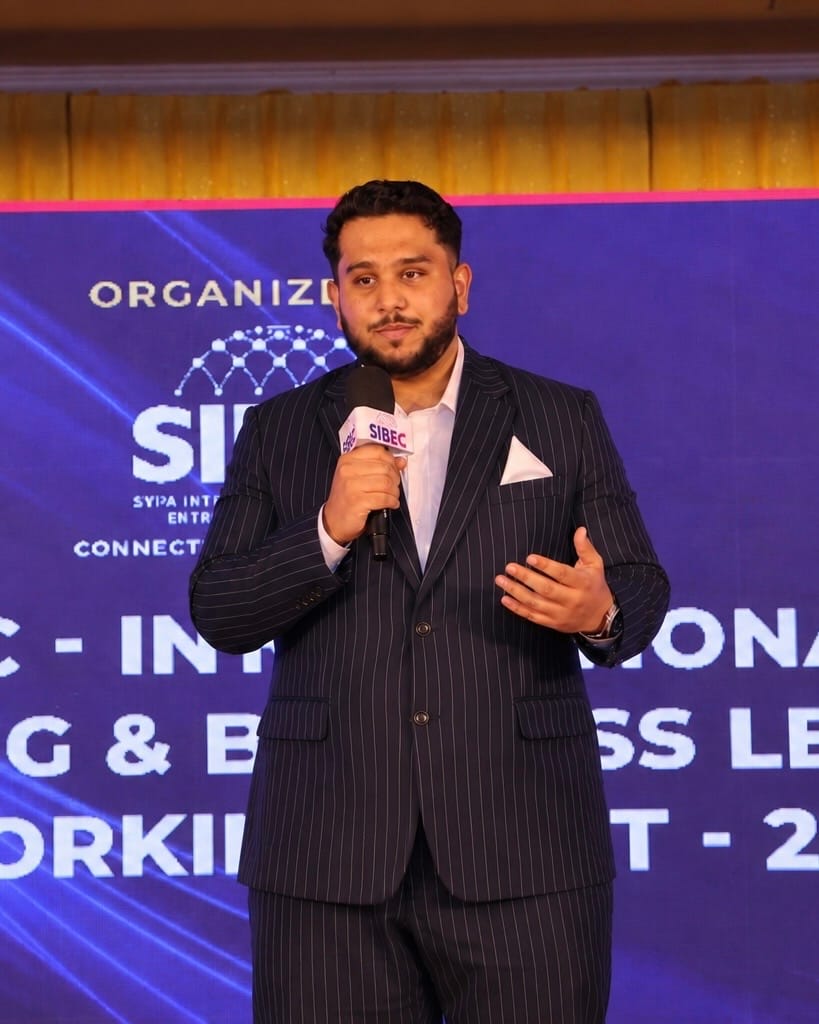
The second change India needs is stronger follow-through. Too many times, I have seen networking treated as the exchange of business cards, LinkedIn connections, and introductions. That creates access, but not a relationship. The discipline shown in the days and weeks afterwards determines whether that possibility becomes commercially meaningful. SIBEC reinforced that for me. The most valuable part was not simply presenting in a room of more than 200 founders, operators, and business leaders from different markets. It was the quality of the conversations that followed, the questions people asked, and the continuation of those discussions after the event. Two of those conversations subsequently became client engagements, which demonstrated that the real value of networking lies not in visibility alone, but in disciplined follow-through.
I would also say this in defence of the Indian market: it is an exacting place to sell. Buyers scrutinise price, question assumptions, and rarely accept a proposition on presentation alone. That can make the process slower, but it also forces better thinking. It teaches you to substantiate value rather than merely assert it.
So the change is not that India needs to become more transactional. It needs to become more deliberate, more value before extraction, more evidence before confidence, and far more discipline after the first conversation.
BOIn: Following up on that, your natural strength is clearly in networking and relationship-driven sales, but your earlier business experience was almost entirely B2C: a women's clothing store, a juice stand, cycle flipping. Those are very different commercial environments. How did you actually develop the instinct for B2B relationship-building, and what did you have to consciously unlearn from selling directly to consumers to become effective at selling to business owners?
LMM: The commercial environments are different, but the underlying discipline is not. Whether you are selling to a consumer or to a business owner, you still have to understand what the other person values, what problem they are trying to solve, and how they perceive the decision in front of them.
My early experience in e-commerce taught me that permanently. What we considered compelling about a product was not always what the customer responded to. Learning to separate my own assumptions from the buyer’s perspective became the foundation for how I later approached B2B conversations. What changes in B2B is the weight of the decision. A consumer is usually deciding for themselves, and the decision can be relatively immediate. They are not simply asking whether they like the proposition. They are asking whether the decision is commercially defensible. That requires a different kind of conversation and I developed that instinct primarily through repetition. I spoke to business owners, made mistakes, reflected on the response, and adjusted the next conversation. There was no single moment when I suddenly became effective at B2B relationship-building. It was cumulative. Every discussion taught me something about timing, language, restraint, and the difference between presenting a solution and genuinely understanding the business first.
One of the most important lessons was to stop treating the first conversation as a pitch. Early on, the natural instinct is to explain everything you can do. Over time, I learned that the stronger approach is diagnostic. You ask better questions, understand where the actual constraint lies, and only then decide whether your solution is relevant. Business owners respond differently when they feel understood rather than processed.
Putting myself in the right environments also accelerated that learning. I deliberately entered rooms where most people were older, more experienced, and operating at a larger scale than I was. There is always some discomfort in that, particularly when you are one of the youngest people present, but the alternative is to remain outside the rooms where your judgement can improve. My father also influenced that development considerably. He has always encouraged me to be fearless, but the more valuable education came from observing him. I watched how he spoke to people, how he maintained composure, how he navigated conversations with senior business figures, and how he treated relationships as something to be cultivated rather than merely used. Those forms of commercial etiquette are difficult to learn from theory alone.
What I had to consciously unlearn from B2C was urgency. In consumer sales, speed, emotion, and immediacy can help move a decision. In B2B, too much urgency can weaken trust. It can make the conversation feel transactional and signal that the seller is more interested in closing than in understanding the consequences of the decision. I also had to unlearn the assumption that every good conversation should produce an immediate outcome. In B2B, a valuable conversation may lead to nothing for several weeks or months. The relationship may develop through follow-up, useful introductions, or repeated exchanges before any commercial engagement begins.
The final shift was from persuasion to credibility. In B2C, the objective is often to stimulate a decision. In B2B, the objective is to become someone whose judgement the other person trusts. The transaction follows more naturally when that foundation exists.
BOIn: You've been deliberate about keeping 100% equity in Concize and staying bootstrapped, funding the business with proceeds from your earlier entrepreneurial success as well as an angel investment from your father, who is a businessman himself. Still, you've also hinted at building a second product that you're more open to raising capital for. Your reasoning around keeping full control of Concize aligns with your long-term vision of building toward an asset management conglomerate. However, it is still an interesting capital strategy for a founder in Bangalore's startup ecosystem, where the default playbook is to raise as early as possible. What's different about this new product that changes your calculus on outside funding?
LMM: My decision to retain full ownership of Concize has never come from an ideological opposition to outside capital. I simply believe that the capital structure should suit the nature of the business. Concize is a service and infrastructure company. It can generate revenue from the beginning, reinvest that revenue, and expand its capabilities alongside demand. In that model, raising institutional capital too early would mean exchanging permanent ownership for a constraint that may only be temporary.
There is also a question of alignment. The moment external investors enter a company, the founder’s accountability inevitably broadens. You are no longer building solely according to your own judgement and time horizon; you are also responsible for delivering against someone else’s expectations of growth, reporting, and return. That is not inherently negative. It is simply a different compass.
For Concize, I wanted the motivation to remain internal.
I wanted to build towards the standard I had set for myself, rather than allowing the company’s direction to become governed by the need to validate each quarter to outside stakeholders. Retaining control allows me to decide which opportunities fit the long-term thesis, which clients we should decline, and where patient development is more valuable than immediate expansion. In this case, the business was initially funded through proceeds from my earlier entrepreneurial work, alongside capital from my father. His involvement was particularly meaningful because he is a businessman himself and understood both the commercial risk and the longer horizon behind what I was attempting to build. It was patient, aligned capital rather than capital attached to an institutional timetable.
On the other hand, the second product changes the calculation because it is structurally different. While Concize can grow through client revenue, a product business generally requires more development before the economics become predictable. In that context, capital is necessary to accelerate product development, deepen technical capability, and enter the market within the relevant window.
There is another strategic alignment as well. My second product is intended for high-net-worth individuals and senior operators, therefore many of the people who could become its earliest users are also capable of investing in it. That creates the possibility of bringing in investors who are not merely financial participants, but informed users, design partners, and sources of distribution. A person who understands the product because they need it can often contribute more intelligently than an investor evaluating it only through a spreadsheet.
Bangalore’s startup ecosystem often treats fundraising as an early marker of legitimacy. I understand why: capital can create momentum and signal confidence. But I do not believe raising money is, by itself, evidence that a company is progressing. It is a financing decision, not a business achievement. My principle is to raise only when capital solves a problem that capital is uniquely suited to solve.
BOIn: Finally, Luqmaan, you're a young founder building in Bangalore, and already serving clients across India, the Gulf, and North America, in a business that sells infrastructure most Indian SMEs are still running without. What does the future of AI-powered business operations look like to you for Indian businesses specifically? Do you think the adoption gap between what's technically possible and what most Indian business owners are actually using is closing, or is it still wider than the technology conversation suggests?
LMM: I think the future of AI-powered operations for Indian businesses will be far less visible than the current technology conversation suggests. The eventual outcome is not that every small or medium-sized business becomes an “AI company.” It is that AI gradually becomes embedded in ordinary operations: responding to enquiries, following up with prospects, preparing quotations, coordinating internal tasks, analysing customer behaviour, collecting feedback, and supporting routine decisions. The owner may not think of these as AI systems at all. They will simply experience a business that operates with greater speed and consistency. There is also a generational transition underway. Many Indian businesses are family-owned, and younger family members are increasingly assuming responsibility for operations. They are generally more comfortable experimenting with digital tools and less attached to processes merely because they have always existed. That does not guarantee successful adoption, but it does reduce the psychological resistance to redesigning how the business works.
On whether the adoption gap is closing, I think the honest answer is that it is closing and widening simultaneously. It is closing because awareness has improved considerably. Business owners no longer need extensive explanations of what AI is. Many have already used tools such as ChatGPT, seen competitors experiment with automation, or encountered AI through the software they use every day. India has already shown, through systems such as UPI, that adoption can accelerate rapidly when technology removes friction and fits naturally into existing behaviour. AI adoption will not necessarily follow the same path, but the principle is relevant.
Businesses do not adopt technology merely because it is advanced. They adopt it when it becomes simple, reliable, and visibly useful.
At the same time, the gap is widening because the technological frontier is advancing faster than most businesses can implement it. By the time an organisation adopts what was considered advanced twelve months ago, the underlying capabilities may already have moved substantially further ahead. There will therefore always be some distance between what is technically possible and what is operationally common. The more important distinction is between experimentation and integration. A business may use AI to write a caption, draft an email, or generate an image, but that does not mean it has become AI-enabled operationally. The real transformation begins when AI is connected to an actual workflow, given reliable context, governed by clear rules, and measured against a commercial outcome. That is where the gap remains considerably wider than the public conversation implies.
This is why I believe the winning model in India will move away from selling isolated tools and towards installing complete systems. A business owner does not necessarily want another dashboard or subscription to learn. They want enquiries answered, follow-ups completed, appointments booked, customers retained, and information available when decisions have to be made. The technology should sit behind that outcome rather than becoming an additional burden for the owner.
Human involvement will remain essential. AI can provide immediacy, consistency, memory, and analytical support, but people remain responsible for judgement, relationships, exceptions, and accountability. The strongest systems will not attempt to remove the human operator. They will allow that person to intervene where their involvement creates the greatest value.