Building the voice AI layer for real estate's multi-million dollar first responder gap

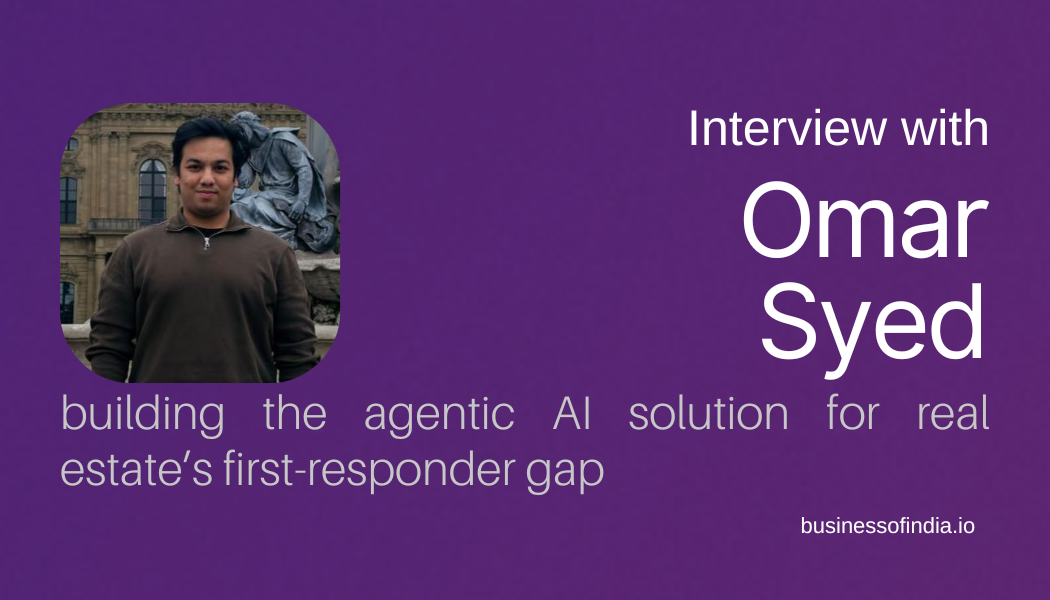
In September 2025, Omar Syed left his thriving agency behind to build in the agentic AI space, a decision that made sense to very few people.
What he wanted to do was create the voice AI layer for every business, and for a while, he seemed to be moving towards that goal. Then, he attended the ATS AI Summit in Berlin, where the lightbulb finally went off.
That moment of clarity has now become Lola AI, a voice AI agent designed to plug the 40% missed inbound calls gap that plagues real estate teams and results in 6+ figure annual revenue loss from potential multi-million dollar closings.
BOIn: You've described the moment you left a stable $2k/month agency business with happy clients and a working playbook, not because things were failing, but because they were "fine." You heard Siam Kidd talk about agentic AI one night and felt you couldn't not make the switch. What specifically did you feel pulled towards when you made that decision?
OS: It wasn't a crisis. That's what made it harder to explain to people. The agency was working. Clients were happy, revenue was consistent, and I had a playbook I could run for years. But "fine" started to feel like a ceiling, not a floor. I was trading time for money in a model where the only way to grow was to add more clients, more hours, more of me. And I remember thinking, "This compounds linearly at best. There's no leverage here beyond my own capacity to grind."
The night I heard Siam Kidd talk about agentic AI, I didn't have some dramatic epiphany. It was more like a recognition. He was describing systems that could operate autonomously, not just automate a task, but make decisions, handle workflows, interact with people. And the thing that hit me wasn't "this is cool technology." I thought about how it is a fundamentally different kind of leverage. Software doesn't get tired. Software doesn't need onboarding. Software scales without me being the bottleneck. That was the gap I'd been feeling in the agency model but couldn't articulate.
The pull wasn't toward AI as a trend. I was more drawn by the idea that I could build something where the value wasn't proportional to the hours I put in. In services, the relationship between effort and output is roughly one-to-one. In software, especially software that replaces or augments labor, the curve bends. One product can serve a thousand customers with nearly the same effort it takes to serve ten. I'd never had access to that kind of economics before, and once I saw it clearly, I couldn't unsee it.
I also knew that if I waited, if I told myself I'd "transition slowly," I'd never leave. The agency would keep being fine, and fine would keep being enough. So I made the switch while the discomfort of staying was still sharper than the fear.
BOIn: Still on your background, you've moved through a wide range of early experiences in a short time; from content to sales, running a marketing agency, doing business development, and now building Lola AI and an investment initiative called Runway Capital simultaneously. Most people take much longer to cover that kind of ground. What's driving the pace, and what have you learned about yourself and your purpose as a builder through this trajectory?
OS: I don't think the pace is strategic. It's closer to compulsive. I see a problem, I want to understand it, and the fastest way I know how to understand anything is to try building something inside it. Content taught me how distribution works. Sales taught me that nothing happens until someone pays. Raizom Media taught me how to run something — not just do the work, but own the revenue, the client relationships, the delivery. VINT taught me what business development looks like inside a company that isn't mine. Each of those was short, but none of them was shallow. I wasn't job-hopping. I was compressing a learning curve.
What I've learned about myself is that I'm not someone who can separate learning from doing.
I can't study entrepreneurship from a textbook and feel like I understand it. I need the client on a call asking why something isn't working. I need the invoice that didn't get paid. I need the campaign that flopped. That's where the real information is.
What I've also learned, and this is harder to admit, is that speed has costs. When you move fast across many things, you sometimes mistake motion for progress. There were stretches where I was busy every hour of the day and couldn't point to a single thing that had actually moved forward meaningfully. I'm getting better at distinguishing between the two, but I haven't solved it.
As for purpose, I'm skeptical of people who claim to have found theirs at twenty. What I have is a pattern. I keep gravitating toward situations where I can build something from zero, where I have to figure out both the product and the market, and where the upside isn't capped by someone else's vision of what my role should be. Whether that's a "purpose" or just a temperament, I'm not sure yet. But I've stopped fighting it.
BOIn: Now let's talk about the current problem you're solving. Lola AI started as a general-purpose voice agent, and then, after your time at the ATS AI Summit in Berlin, you made a deliberate decision to go all-in on real estate.
You've described that as a focus decision driven by one painfully obvious problem: missed calls, slow lead response, agents losing commissions to voicemail or buyers simply moving on to the next agent. What did it take to arrive at that clarity, and what part of the vision did you have to let go of when you narrowed the target?
OS: When Lola started as a general-purpose voice agent, the pitch sounded great in the abstract. We could theoretically serve anyone, clinics, law firms, e-commerce, real estate, restaurants. But, every time we tried to go deeper with a potential customer, we hit the same wall: every industry has different workflows, different CRMs, different definitions of what a "qualified lead" even means.
We were building a horizontal product with vertical complexity, and we didn't have the resources to do that well.
At the ATS AI Summit in Berlin, I spent two days talking to founders who had focused, and I could see the difference. They knew their customer's problems at a granular level. They didn't just say "businesses lose money from missed calls," but exactly which calls, at what times, what the cost per missed opportunity was, and how the current workaround failed. I didn't have that depth for any single vertical. At best, I had surface-level knowledge across five of them.
Real estate stood out because the pain was quantifiable and the buyer was identifiable. Agents work on commission. A single missed buyer call can cost them tens of thousands, and most agents don't have receptionists. They're on showings, in meetings, driving between properties. The phone rings, nobody picks up, and the lead calls the next agent on Zillow. That's real money leaving their pocket every week.
What I had to let go of was the fantasy of building a platform. I wanted Lola to be the "voice AI layer for every business." That sounds ambitious, but it's actually a way of avoiding the hard work of going deep. Narrowing to real estate meant accepting that the first version of this company would be smaller than what I'd imagined. But it would be real, and real is what compounds.
BOIn: You've been candid about where most voice AI tools fail: they demo well but fail once deployed. The real engineering challenge, in your view, isn't getting latency down or making the voice sound natural. It's integration, making the agent plug into the actual CRM, booking flow, and qualification logic of each specific business. How are you solving that deployment problem for Lola AI, and what does the onboarding process actually look like?
OS: Most voice AI demos are impressive for about 90 seconds. The voice sounds natural, the latency is low, and the conversation flows. Then you ask: "Okay, but how does this connect to the agent's CRM? How does it know which listings are active? How does it route a hot lead differently from someone asking about open house hours?" That's where most products fall apart.
The core engineering problem with voice AI isn't the voice. That's largely commoditized at this point, there are good models, good text-to-speech engines, good transcription layers. The hard part is what happens after the call ends. Does the lead show up in the agent's CRM with the right tags? Does the calendar booking actually work with their existing system? Does the qualification logic match how that specific brokerage defines a serious buyer versus a casual inquiry? If the answer to any of those is no, the agent stops using it within a week.
Our onboarding process is built around this reality. We don't hand someone an API and wish them luck. We start with a workflow audit — what CRM are they using, how do they currently handle inbound calls, what's their follow-up process, what counts as a qualified lead in their market. Then we configure Lola to fit into that existing flow, not replace it. The agent shouldn't have to change how they work. The AI should adapt to them.
That means integration is where most of our engineering time goes. Not on making the voice sound one percent more human, but on making sure the data lands in the right place, the booking logic is correct, and the handoff to a human agent is seamless when the situation calls for it. It's unglamorous work. But it's the difference between a product someone demos and a product someone depends on.
BOIn: Lola's pitch to real estate agents is built around some interesting stats. 40% of inbound calls go to voicemail, 78% of buyers work with the first agent who responds, and one missed buyer call can cost more than Lola costs for an entire year. How did you arrive at that framing, and what does it tell you about how to sell to an industry that isn't traditionally early to adopt new technology?
OS: Research and talking to agents; that's how we got there. The 40% missed-call rate is well-documented across the industry. Multiple studies have shown that real estate agents miss a staggering share of inbound calls, especially during business hours when they're on showings or with other clients. The 78% speed-to-lead stat comes from NAR data and industry research on buyer behavior: buyers overwhelmingly work with whoever responds first. When you put those two facts together, the math writes itself.
If you're missing nearly half your calls and the buyer will hire the first person who picks up, you're hemorrhaging revenue you never even see.
What made the framing effective was how specific we got. Real estate agents think in terms of commissions, not SaaS metrics. So instead of saying "improve your lead conversion rate," we say: "One missed call from a buyer on a $400,000 listing could cost you $12,000 in commission. Lola costs a fraction of that per year." That reframes the product from an expense to a form of insurance against lost income. You're plugging a hole in your revenue, rather than just buying another software.
Selling to an industry that isn't early-adopting requires you to meet people in their language, not yours. Real estate agents don't care about AI. They care about closings. They care about not losing a deal to the agent down the street who happened to answer the phone. When you frame the product around that anxiety — which is real, not manufactured — adoption becomes much easier.
The other thing I've learned is that proof matters more than promises in these markets. We don't lead with a vision of the future of AI. We lead with: here's what happened when an agent in your market turned Lola on for thirty days. That kind of evidence is slow to build, but once you have it, it sells better than any pitch deck.
BOIn: Alongside Lola, you've launched Runway Capital, a long-term, high-conviction investment initiative focused on US equities and asymmetric opportunities in AI infrastructure and emerging technology. Those are two very different things to be building simultaneously. How do they inform each other? Is there a point at which you think you'll have to choose, or is the plan to genuinely run both for the long term?
OS: They look like two different things from the outside, but from the inside they use the same muscle. Building a company forces you to understand how businesses actually work — unit economics, customer behavior, competitive dynamics, what makes something defensible versus fragile. Investing forces you to do the same thing, just from the outside looking in. When I'm evaluating a company for Runway, I'm asking the same questions I ask about Lola: Is the problem real? Is the moat structural or cosmetic? Will this matter in five years or is it a cycle?
I always stress that Runway isn't a fund. It's a long-term investing project, with concentrated, high-conviction positions in companies and sectors I understand deeply, primarily AI infrastructure and technology. It started because I realized that understanding markets wasn't separate from understanding business. They're the same discipline applied at different altitudes.
The way they inform each other is concrete. Building Lola has made me a significantly better investor because I now know what "integration complexity" actually means when an AI company claims enterprise readiness. I know what customer acquisition looks like when you're selling to a fragmented, non-technical market. That pattern recognition is impossible to get from reading 10-Ks alone. Conversely, the investing lens forces me to be honest about Lola's weaknesses. When you spend time evaluating other companies' margins, retention, and competitive positioning, you can't avoid applying the same scrutiny to your own.
Will I have to choose eventually? Maybe. If Lola reaches a stage where it demands every waking hour and the opportunity cost of splitting attention becomes real, I'll make that call. But right now, the two are complementary. Runway makes me a more disciplined founder. Lola makes me a more informed investor. I don't think they conflict until one of them requires scale that the other can't coexist with. I'm watching for that moment, but I'm not there yet.
BOIn: Finally, you're an Indian founder, educated early in Bangalore, now studying further in Germany, building a voice AI product for the UK and US markets. That's a true position of competing globally from day one, with a background and instincts shaped mostly by the Indian context.
What do you think Indian-trained talent can bring to building for non-Indian markets? What does the world still get wrong about what India produces, beyond the stereotype of 'strong engineers who execute other people's ideas'?
OS: The honest truth is India doesn't have one context.
I grew up in Bangalore, which is arguably the most globally connected city in the country. The tech culture there isn't a copy of Silicon Valley, but it's deeply intertwined with it. So when people frame Indian founders as outsiders trying to break into Western markets, that doesn't match my experience. The global market wasn't something I had to "access." It was already in the air I was breathing while growing up.
That said, there's something India trains you for that I think is genuinely underestimated: operating in chaos. India is a country where nothing works the way it's supposed to, and yet everything works. You learn to build systems that function despite unreliable infrastructure, inconsistent information, and resource constraints that would paralyze someone who grew up assuming things would be smooth. That's not an engineering skill. It's an operational instinct. And it's incredibly valuable when you're building a startup, because startups are chaos by definition.
The stereotype of Indian talent as "strong engineers who execute" is outdated, but it persists because the most visible Indian contribution to global tech has been through services companies — Infosys, TCS, Wipro — which were built on execution, not invention. What's changed is that a generation of Indian founders now has the ambition, the market awareness, and the capital access to build products, not just deliver projects. The founders coming out of India right now aren't waiting for someone in San Francisco to define the problem. They're defining it themselves.
I can stretch a budget further than most founders in Western Europe because I learned to build with less. And being in Germany, selling to UK and US markets, having grown up in Bangalore — that cross-cultural exposure means I don't build products with one market's assumptions baked in.
I build for the problem, and the problem doesn't have a passport.