Creating a pathway towards Research OS with AI

Over 3 million scientific papers were published in 2025 alone.
For an academic researcher, a single query can turn up more than 50k papers, with no filters for relevance, organization, tracking, or extracting relevant data.
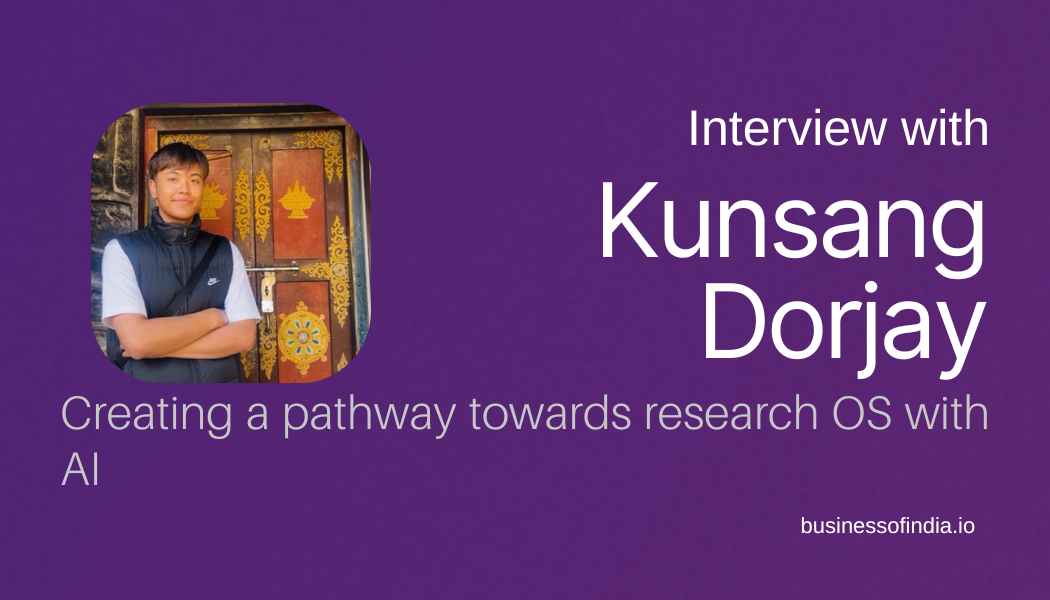
This is why Kunsang Dorjay is building Nagi, an AI-native research tool built on one thesis: synthesis over search. We had a chat about building for the world from Darjeeling, India, being a serial young founder with Y Combinator aspirations, and what the future of research could really look like.
BOIn: You are building AI companies from Darjeeling, a part of India that doesn't typically appear in the startup conversation. What is your experience building from that geography without the traditional support system you’d have in, say, Bangalore or Delhi?
KD: Yes, when you think about the Indian startup ecosystem, the conversation is usually centered around places like Bangalore, Delhi, Mumbai, or Hyderabad. Darjeeling isn't naturally part of that ecosystem, so I didn't have the same access to startup networks, mentors, investors, or a large technology community around me, but I think that constraint has actually shaped how I build. I started learning and experimenting largely through the internet — building projects, joining global communities, working with open-source tools, talking to people online, and figuring things out as I went. Instead of having a startup ecosystem physically around me, I had to create my own ecosystem digitally.
In a strange way, Darjeeling has made me more comfortable with uncertainty. I've learned that if the ecosystem doesn't exist around you, you can either wait for it to appear or start building your own network and opportunities. You become very aware that geography shouldn't determine the scale of your ambition. Where you start can influence your journey, but it doesn't have to define the scale of what you build. If I'm building an AI product, my users don't have to be in Darjeeling. They can be in Bangalore, London, San Francisco, or anywhere else in the world. The internet completely changes that equation.
At the same time, I don't want to romanticize the lack of infrastructure or support. There are real challenges. For instance, access to experienced founders, technical talent, funding networks, and the opportunities to meet the right people is much harder. I've had to compensate for that by being extremely proactive about reaching out, learning independently, and building relationships outside my immediate environment.
BOIn: At 19, you founded your first venture Deexen AI, built a team of 12 developers from across India, got pre-incubated at AIC SMIT, applied to Y Combinator, got rejected, and then shut it down with what you described as clarity rather than defeat. Tell us a bit about that, what was the Deexen chapter actually like?
KD: Deexen was probably the most intense learning experience I've had as a young founder. I started it with a very simple belief: that the way developers learn and build software could be fundamentally improved with AI. From there, it eventually became a real company effort. We built the team with a dozen people from different parts of the country, worked with users, and even took the step of applying to YC.
From the outside, those things can look like a straight line of progress but internally, it was much messier. I was learning product, engineering, leadership, hiring, communication, and decision-making all at the same time, often by making mistakes first. I was also learning that building something technically impressive doesn't automatically mean you're building something people desperately need. I became much more conscious of the difference between building a product and building a company. There were times when I was too attached to the idea itself and not critical enough about whether the direction was actually working.
Eventually, I made the decision to shut Deexen down, which was probably harder than starting it. When you've spent months building something, assembled a team around it, and told people about the vision, shutting it down can feel like admitting that you failed, but I eventually realized that continuing something simply because I'd already invested so much into it would have been the bigger failure. My most important personal takeaway from that experience is that I'm more attached to building than I am to any particular idea. Before Deexen, I think I subconsciously believed that being a founder meant having the determination to never give up. After Deexen, I think differently. Sometimes determination means continuing through difficulty. Sometimes it means having enough clarity to say, "This isn't the right thing anymore," and starting again.
BOIn: And now, you are on your next idea, Nagi, and this time around, your core thesis is 'synthesis over search'. You found that the problem for most academic researchers isn't finding papers but understanding which ones matter, how they relate to each other, where the field is actually headed, and where the gaps are, basically a relevance issue. How did you arrive at that framing, and what made you confident it was the right problem to organise an entire product around?
KD: Actually, I experienced the problem myself while working on research-heavy projects. I found that most of my time was actually spent jumping between papers, trying to understand connections, building mental maps, taking notes, comparing methodologies, and figuring out what the collective body of research was actually saying. That's when the idea of synthesis became important to me. I started thinking about research as a network of ideas because while most dedicated software will treat them as individual documents, papers don't actually exist in isolation. They build on other work, challenge other work, introduce methodologies, create new directions, or open questions that someone else eventually answers.
Today, if you're a student or an early researcher, you can find papers incredibly easily. Google Scholar, Semantic Scholar, arXiv, and other tools have made retrieval almost trivial. The difficult part comes afterwards, when you might have 20, 50, or 100 papers in front of you. Then the questions become, "Which of these actually matter? Which papers are foundational? Which ones contradict each other? How did this idea evolve? What are researchers currently disagreeing about?" And perhaps most importantly, "where is the unexplored space?"
I wouldn't say we started Nagi because we believed search was broken. Search works remarkably well for getting information, but research requires understanding.
So Nagi's thesis became: don't just help researchers find information; help them understand the structure of knowledge.
That also changed how we thought about the product. Instead of building another search box with an AI chatbot attached to it, we started thinking about Nagi as an environment where you could discover papers, map their relationships, compare them, identify important developments, and gradually construct an understanding of a research area.
What then gave me confidence in the problem was how consistently it appeared whenever I watched people actually do research. The workflow is incredibly fragmented: search in one place, read PDFs somewhere else, take notes somewhere else, compare things manually, and keep the relationships between ideas mostly inside your head. It felt like a fundamental product opportunity.
BOIn: It's interesting to hear how you describe Nagi as a full environment, so let's talk about that architecture for a bit. Nagi has several layers, with each one solving a different stage of the research process. How did you decide the sequencing? As you have assembled these independent blocks, where have you observed the realest friction for your users versus where you assumed it would be?
KD: I realized quite early how much I had initially overestimated the friction in discovery. As I have mentioned, finding papers is already relatively easy. The challenge mostly begins once you have dozens of papers open with different terminologies, different methodologies, conflicting results, and no direct path to a coherent mental model. That's where synthesis and organisation started becoming much more important to me.
It also influenced the Research Map concept in Nagi because I didn't want to build another research chatbot where you simply upload a PDF and ask questions. I wanted to create a space where I could actually see how papers and ideas connect, move things around, add my own thinking, and gradually build an understanding of an entire research area. That structure wasn't designed perfectly from day one. It evolved as I started breaking the research workflow down into the actual problems I was experiencing. Initially, I saw research as a fairly linear process: discover papers, understand them, synthesize the information, identify gaps, and eventually write. That naturally led me to six layers: Discover, Understand, Synthesize, Gap Detection, Write, and Organise. However, as I started actually building Nagi, I realized that research isn't really that straightforward. You might discover a paper, start reading it, realize you need to go back and find the papers it references, compare it with another paper, discover a contradiction, reorganize your thinking, and then return to discovery again. It's much more of a loop.
Because I'm building Nagi myself, I'm constantly going through that workflow personally. I'm not just designing the architecture theoretically; I'm also actively using the product, which has made the process much more iterative. You don't really know where the friction is until you build enough of the workflow to experience it yourself. Every time I hit a pause in my own research workflow, I have to ask myself, "Is this just my problem, or is this a deeper problem in how research is currently done?" So the architecture has become less about six separate features and more about a continuous research loop.
BOIn: You have applied to Y Combinator with Nagi, and also been accepted into Claude for Startups. What does early institutional recognition like that change about how you build?
KD: I think early institutional recognition gives you confidence, but it shouldn't give you certainty. Applying to Y Combinator a second time with Nagi was interesting for me because I was coming at it from a completely different place. With Deexen, I was very attached to the idea and still figuring out what it meant to build a company. With Nagi, I had already gone through the experience of building something, assembling a team, getting rejected, and ultimately having the discipline to shut it down. So the second application wasn't about proving that I could get into YC. It was more about putting Nagi in front of people who have seen thousands of startups and seeing whether the problem and the direction resonated.
Getting accepted into Claude for Startups has been valuable in a different way. It gives me access to better tools and resources and, more importantly, signals that the work I'm doing is being taken seriously by people outside my immediate environment, but I don't think recognition changes the fundamental job. It doesn't mean Nagi has product-market fit. It doesn't mean the product is going to succeed. It doesn't mean I'm building the right thing. The users still have to care. If anything, I think recognition creates a responsibility to be more rigorous. Once someone credible gives you a vote of confidence, it's very easy to start believing your own narrative. I try to separate the external validation from the actual evidence I'm getting from building and using Nagi.
However, the biggest thing that has changed is probably my confidence in thinking bigger. Coming from Darjeeling and building independently, it's easy to wonder whether you're even playing in the same arena as founders coming from major startup ecosystems. Programs like Claude for Startups and opportunities like YC make that distance feel much smaller, but I like to emphasize that they don't change the fundamental equation. At the end of the day, I still have to build something people genuinely need. That's actually something I learned from Deexen. Recognition can open doors. It can give you credibility, resources, and access, but it cannot build the company for you. The product still has to earn its place.
BOIn: A very interesting part of Nagi is where you have talked about eventually creating MatterOS, essentially a domain-specific branch for materials science, aimed at helping researchers in fields like batteries, semiconductors, and medicine move faster by navigating literature and connecting evidence at scale. What's the actual path from where Nagi is now to that research OS you're describing?
KD: Today, Nagi is still a relatively focused product. The immediate problem I'm solving is helping students and early researchers discover, understand, connect, and synthesize academic literature. I don't want to pretend that I've already built a research operating system. I haven't. The reason I think the larger vision is reachable is that I'm starting with what I believe is the fundamental layer: understanding the relationships between knowledge. If Nagi can reliably help someone go from a research question to the relevant literature, understand the important papers, map how ideas and evidence connect, identify contradictions and gaps, and eventually build a defensible research direction, then it can gradually move beyond being a literature-review tool.
The path I see is essentially literature intelligence → research workflow → research environment.
I think the important distinction is between the product Nagi is today and the direction I believe it can grow into. The first step is making discovery and synthesis genuinely useful. Then I want Nagi to own more of the research workflow, from organising evidence, maintaining research maps, tracking developments in a field, helping researchers formulate questions, to eventually assisting with writing while keeping the underlying evidence traceable. Only after that foundation is strong does the larger opportunity become interesting, where we can apply the same intelligence to specific scientific domains.
I previously explored the idea of MatterOS around materials science, but I've moved away from treating it as a separate venture. I think the better long-term architecture is to build Nagi's core intelligence first and then develop domain-specific capabilities on top of it. For example, materials science has completely different terminology, datasets, relationships, and research workflows from perhaps medicine or semiconductor research. Nagi shouldn't pretend those domains are identical, but the underlying problem of navigating an enormous and constantly expanding body of knowledge is remarkably similar. For that larger vision to be reachable, a few things have to be true.
First, the synthesis has to be trustworthy. In research, a confident hallucination can lead someone in the wrong direction, so it's very high stakes. Every important claim needs to be grounded in evidence. Second, Nagi needs to understand relationships, not just documents. The long-term advantage isn't simply having a better paper search engine. It's understanding how papers, methodologies, findings, researchers, and ideas connect over time. Third, researchers need to actually make Nagi part of their workflow. That's why I'm focused on the wedge rather than trying to build everything at once, and finally, I have to prove that Nagi can create a meaningful improvement in how people conduct research. If it can take something that currently takes a researcher days or weeks of fragmented work and make it substantially faster without sacrificing rigor, then I can earn the right to build the larger vision by solving one increasingly important piece of the research process extremely well.
BOIn: You recently opened a role for a technical co-founder and received over 20 applications. Yet, after weeks of these conversations, you still couldn't find the right person. What are you now looking for that you weren't originally evaluating when you opened the search?
KD: I spoke with people who were objectively very impressive, engineers who had built systems at scale, worked at startups, had strong AI and ML backgrounds, and in some cases had already been founders themselves. So initially, I thought the question would be, "Can this person technically build Nagi?" After having those first conversations, I realized that was the wrong question. Of course technical ability matters, but as a technical co-founder, I don't need someone who simply has the skills to implement what I tell them. I need someone who can look at the problem with me and say, "I think this is wrong. Here's what we should build instead," and then actually go build it. That's where I started seeing the gap, because there is a significant difference between being excited by an ambitious idea and being willing to carry an ambiguous problem for years.
A lot of people are attracted to ambitious companies because the vision sounds exciting. They want to work on AI, build something global, and get the startup experience, but there's a very different mindset required when the path isn't clear. At the early stage, there isn't a perfectly defined job description, and there isn't always a roadmap. There are weeks where something you've spent a huge amount of time building turns out to be wrong. You have to be comfortable making decisions with incomplete information and continuing anyway.
The search also changed what I'm looking for. Initially, I was screening heavily for technical credentials. Now I'm much more interested in evidence of ownership, so I am better at asking questions that inquire beyond the surface expertise.
"What have you built when nobody asked you to? What did you continue working on when it stopped being exciting? Have you ever taken an idea from zero to something real without someone giving you the roadmap? How do you behave when your first ten attempts don't work?"
Those tell me much more about a potential co-founder than a résumé does. So I'm still looking for someone technically exceptional, but that's no longer the differentiator. I'm looking for someone who sees Nagi and doesn't just think, "I'd love to work on this."I want someone who thinks, "This problem needs to be solved, and I'm willing to take responsibility for solving it with you." It's a much smaller pool, but I think that's where I should be looking.
BOIn: You've now applied to Y Combinator twice, a Silicon Valley institution that remains the most globally recognised signal of startup legitimacy. What does that say about the state of India's AI startup ecosystem right now? Is the country building the infrastructure to back ambition at your level, or are founders who want to build something that competes globally still essentially dependent on Western validation and Western capital to be taken seriously?
KD: I think India's AI startup ecosystem has changed dramatically, but there is still a gap between having the ability to build globally competitive companies and having an ecosystem that consistently supports those companies from day zero to global scale. I say this mainly because the ability to build is no longer the major limitation. The talent is here. The engineering capability is here. The cost structure is incredibly attractive. India has an enormous technical population, a rapidly growing AI ecosystem, and increasingly strong access to global infrastructure and models. What I think is still developing is the density of the ecosystem around ambitious founders, especially outside the major startup hubs. My own experience has made that particularly obvious. I'm building from Darjeeling, so I don't have the same physical proximity to investors, experienced founders, researchers, or startup networks that someone in Bangalore might have. The internet has allowed me to compensate for a lot of that, but it doesn't completely replace being surrounded by people who are building at the same level.
Then there's the question of global validation. I don't think founders should need Western validation to prove that an Indian company is legitimate, but realistically, institutions like YC have enormous global distribution and credibility. If you're building something intended for a global market, being recognized by an institution like that can accelerate access to investors, talent, customers, and other founders. That's not necessarily because India lacks capability. It's partly because startup ecosystems are network effects. Silicon Valley has spent decades accumulating capital, talent, companies, and institutional knowledge in one place, but I also think the equation is changing. Indian founders increasingly aren't building companies specifically for the Indian market and then thinking about the rest of the world later. They're building global products from India from day one. AI makes that particularly interesting because software can be distributed globally without requiring a physical presence in every market.
So I don't see YC or Western capital as the permission slip to build a global company. I see them as accelerators. The important question is whether the company can create something globally valuable. If it can, I don't think the founder's geography should ultimately matter, and that's probably why I'm comfortable building Nagi from where I am. I don't want the lesson of my experience to be that you have to leave India to build something world-class. I'd rather prove the opposite: you can start from a place that isn't traditionally considered part of the startup map, build for the world, and eventually make the geography almost irrelevant.