The real skill startup founders need to win in Indian markets

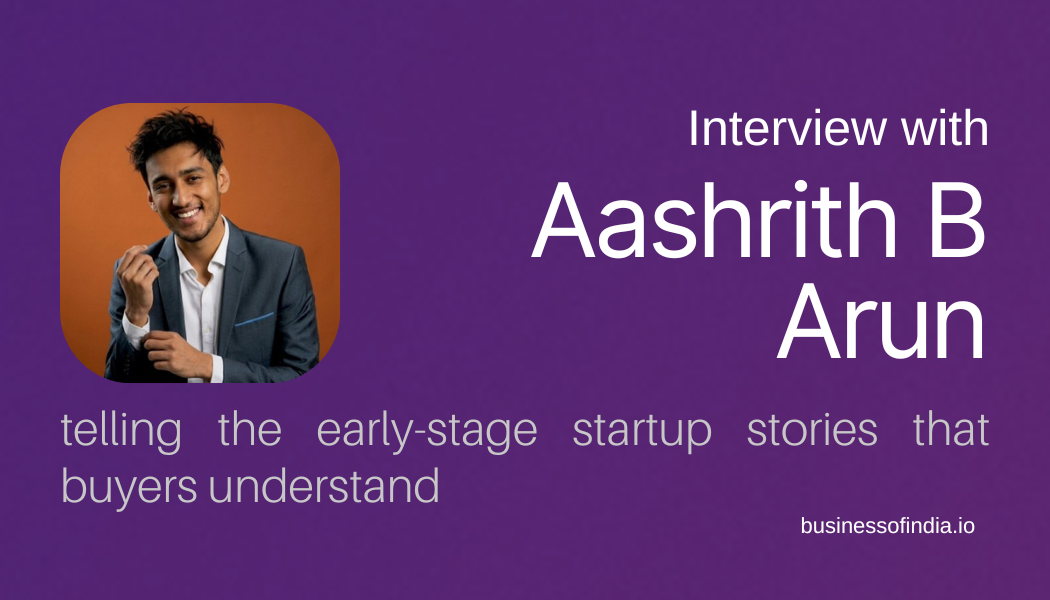
Aashrith B Arun understands a fundamental truth that far too many startup founders miss. Stories sell.
In 2023, he left behind his job in technology consulting at Deloitte to pursue an MBA at the University of Bath. The goal was simple: get the degree and pivot into business strategy.
Once he returned to India, he kick-started his new path with a stint as Head of Growth and Strategy at premium apparel brand Wellbi. This was where he noticed something very interesting. Through a series of storytelling-driven campaigns, brand engagement went up by 38% while new customer acquisition also jumped by 22%.
The path from here was immediately obvious.
In late 2025, Aashrith teamed up with his MBA classmate Raksha Jadav and co-founded Figment Theory, a strategy-first consulting practice helping early and growth stage startup founders to solve 'high-stakes clarity problems' in positioning, messaging, and product narrative.
BOIn: Figment Theory's founding insight was something you kept observing repeatedly: great products would have weak stories, while on the inverse side, polished narratives would be wrapped around experiences that didn't deliver. You describe the problem as a clarity gap. After working with 70+ startups, has your diagnosis of what that gap actually is sharpened or shifted? What do you now understand about why it's so persistent?
ABA: It has definitely sharpened. When we started Figment Theory, we thought the problem was primarily a communication problem. We believed founders struggled to explain what they were building. Today, I think the issue runs much deeper.
Most founders are not actually struggling to communicate; they’re struggling to achieve clarity themselves.
Building a company is chaotic. Founders are simultaneously talking to customers, investors, employees, partners, and the market. Over time, every conversation adds a layer of complexity. What starts as a simple idea slowly becomes buried under features, assumptions, industry jargon, and competing priorities. The result is that many companies lose sight of the simplest articulation of why they exist and why anyone should care.
That’s why the gap is so persistent. It’s a thinking problem and not a branding one. Branding simply exposes it.
The most effective founders I’ve worked with are not necessarily the best storytellers. They’re the clearest thinkers. Once clarity exists internally, good positioning, messaging, design, and go-to-market execution become much easier. Our role is often less about creating a story and more about uncovering the one that already exists beneath the noise.
BOIn: Very clear insight there, Aashrith. Clarity is the foundation that entire business models run on, and in many cases, founders can fall short there.
Going further on that note, Figment Theory operates entirely by referral. You work with a deliberately small number of founders each quarter and position yourselves as a premium, hands-on partner rather than an agency. Those are three choices that run counter to the conventional playbook for scaling a consulting practice. What made you commit to that model, and what has it required you to say no to?
ABA: From the beginning, we never wanted to build an agency in the traditional sense because agencies are often incentivized around volume, utilization, and deliverables. We were more interested in outcomes. That naturally pushed us toward a smaller, more selective model.
The kind of work we do sits at the intersection of strategy, product thinking, storytelling, and execution. It requires deep immersion. You cannot parachute into a company for a few meetings, create a slide deck, and expect meaningful results. The best work happens when you understand the founder, the market, the product, and the long-term ambition behind the business.
Referrals became a natural consequence of that approach. If the work creates value, the next conversation usually arrives through trust rather than outreach.
The trade-off is that we’ve had to say no to growth opportunities that looked attractive on paper. Larger retainers, higher client volume, and projects that would have generated more revenue, but diluted our involvement. We’ve repeatedly chosen depth over scale.
That decision may slow growth in the short term, but it preserves the thing that makes the work valuable in the first place.
BOIn: Speaking of momentum, you're simultaneously running Figment Theory while also a co-founder at Wakanda Innovations Lab, leading GTM and brand strategy at RETAiLABS, building The Sodopreneur, and mentoring at CoreSmart AI. You're also doing active branding work for Bharat Semi, a semiconductor and defence electronics company, which is about as far from a D2C startup as it gets.
What does the range of that portfolio tell you about where your thinking is actually heading? How do you balance it all?
ABA: On the surface, those look like very different worlds. A creator platform, a semiconductor company, an AI startup, a retail technology platform, and a venture studio don’t appear to have much in common. But I’ve increasingly realized that I’m drawn less to industries and more to systems.
Whether it’s a startup, a creator business, or a deep-tech company, the underlying challenge is often the same: turning complexity into clarity and translating potential into adoption. Different sectors have different vocabulary, but many of the core principles remain surprisingly consistent.
The portfolio reflects a growing interest in the intersection of technology, business, and human behavior. I’m fascinated by how ideas move from concept to market, how products earn trust, and how organizations create leverage.
As for balance, I don’t think about it as balancing five different jobs. I think about it as operating within one interconnected ecosystem. Each project informs the others. The lessons from a semiconductor company can shape how I think about positioning. Insights from creators can influence product adoption. The cross-pollination is often where the most valuable ideas emerge.
BOIn: So you are essentially finding value at that intersection, which makes so much sense as an approach. Let's dial into one of those projects for a bit. The Sodopreneur has a specific long-term vision: to build a creator-first ecosystem that produces entrepreneurs, not just influencers. That's a meaningful distinction, but what does it mean in practice? Why do you think the creator economy in India has defaulted so heavily toward influence rather than toward building?
ABA: It's honestly quite simple. Influence is attention. Entrepreneurship is ownership.
The creator economy has become exceptionally good at helping people acquire audiences. What it hasn’t done as effectively is help people convert that audience into assets, businesses, products, communities, intellectual property, or long-term value.
The Sodopreneur exists because I believe content should be a means, not the destination. In practice, that means helping people think beyond views, likes, and followers. It means encouraging creators to build skills, products, systems, communities, and businesses that can outlast any individual platform or algorithm.
I don’t think India’s creator economy intentionally chose influence over building. It simply evolved that way because attention is easier to measure and reward. Views are immediate. Businesses take years.
But we’re beginning to see a shift. More creators are becoming operators, founders, investors, educators, and community builders. I think the next generation of successful creators won’t be defined by audience size alone. They’ll be defined by what they’ve built around that audience.
BOIn: Beyond the creator economy, you've worked with startups across AI, SaaS, retail tech, semiconductors, and consumer brands, which gives you a cross-sectoral view of how early-stage Indian companies present themselves to the world. What's the most consistent pattern you see in how Indian founders struggle to tell their story? Do you think it's a skills gap, a confidence gap, or something more structural about how building is valued versus how storytelling is valued in the culture?
ABA: I don’t think it’s purely a skills gap or a confidence gap. It’s partly cultural. India has historically celebrated builders, engineers, operators, and executioners. Those strengths have helped create an incredible generation of companies. But communication and narrative have often been viewed as secondary disciplines rather than strategic capabilities.
The irony is that some of the world’s most successful companies succeeded because they combined both. Great products create value. Great stories create belief. The strongest companies understand that you need both. Look at examples like Nike and Apple.
The most common pattern here is that founders underestimate the strategic value of storytelling.
Many founders treat storytelling as something that happens after the product is built. In reality, storytelling influences hiring, fundraising, partnerships, customer acquisition, adoption, and culture long before a company reaches scale.
BOIn: Going into another corner of your portfolio, Bharat Semi, which is working on sensors for defence electronics, military surveillance, and autonomous systems, squarely in India's emerging deep-tech and strategic technology space. What does working on that kind of company tell you about where India's technology ambitions are actually pointed, beneath the startup and consumer internet narrative that usually dominates the conversation?
ABA: It has reinforced my belief that some of India’s most important technology stories are being built far away from public attention.
The startup conversation often focuses on consumer internet, fintech, and software because those sectors are highly visible. But underneath that layer, there is a growing ecosystem of companies working on semiconductors, defence technologies, advanced manufacturing, AI infrastructure, robotics, and strategic systems. These are not businesses optimized for headlines. They’re businesses focused on national capability.
What excites me is that the ambition is changing.
For a long time, India was primarily seen as a services and software powerhouse. Increasingly, we’re seeing founders ask a different question: "What critical technologies should India own?"
That shift matters because deep technology creates long-term strategic advantages. It influences economic resilience, national security, supply chains, and technological sovereignty. I believe we’re still in the early stages of that transition, but the momentum is real.
BOIn: That is a truly fascinating insight, Aashrith, and we couldn't agree more that a lot of the most important work actually falls outside the radar of the headlines. Which brings us to a quite important question about visibility. You built Figment Theory from Mysuru, not Bangalore, not Mumbai, not Delhi. What does that choice mean to you? What do you think it signals more broadly about where the next generation of Indian creative and strategic talent will come from, and whether the old geography of opportunity is starting to break down?
ABA: For me, Mysuru was never a compromise. It was a deliberate choice.
For decades, opportunity was concentrated in a handful of cities because access to networks, capital, talent, and information was geographically constrained. That’s becoming less true every year.
Today, a founder in Mysuru can collaborate with a team in London, work with clients in Bengaluru, build products with engineers across India, and learn from experts globally. The barriers are dramatically lower than they were even a decade ago. What matters now is less about where you are and more about what you’re connected to.
I think the next generation of Indian talent will emerge from a far broader set of cities than we’ve traditionally expected. Places like Mysuru offer something valuable: lower noise, stronger focus, lower operating costs, and the ability to build patiently.
The geography of opportunity isn’t disappearing entirely, but it’s becoming far more distributed. That’s a positive shift. Some of the most interesting companies of the next decade may not come from the usual startup hubs at all.
Connect with Aashrith on LinkedIn and check out Figment Theory!