Disrupting India's luxury resale market by placing trust first

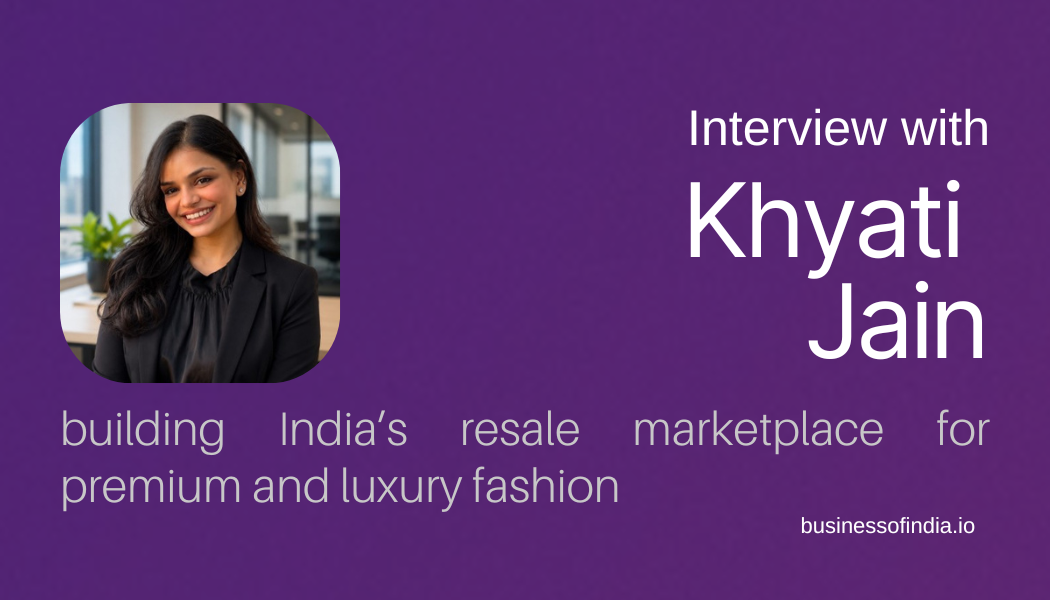
When Khyati Jain decided she was going to set out to create the infrastructure for circular fashion in India, the first question she got was, "Who is going to buy a second-hand Gucci bag here?"
But at Cycle of Samsara, the peer-to-peer marketplace she now operates with her co-founder Vanshika Modi, the mission is more than reselling Gucci bags.
It is about tapping into India's $15bn luxury and occasion wear market, where the majority of value remains trapped in wardrobe excess and fashion waste. It is about fixing a problem Khyati herself faced after every wedding, graduation, trip, milestone and festival when the expensive outfit would go in the back of her closet, never to be reworn.
This is where Cycle of Samsara finds its double-sided competitive wedge; targeting the upscale segment of wedding, ethnic and premium occasion wear, then adding a strict authentication layer that several resale platforms miss, especially when operating in a quality-oriented market like India.
BOIn: Your career before Cycle of Samsara moved through PR & marketing into creative direction at children's apparel brand Pink Mermaid. You even did fashion design briefly at a Kolkata-based firm.
In hindsight, it appears you were building a working knowledge of how the fashion industry operates from multiple angles simultaneously. Was that deliberate, or did it emerge from following what was interesting? And looking back now, which of those experiences turned out to be most useful for what you're building?
KJ: It was a bit of both. At the time, I wasn't consciously building towards a startup. I was simply drawn to different parts of the fashion industry and wanted to understand how everything worked.
PR taught me how brands build aspiration. Marketing taught me consumer behaviour and growth. Creative direction taught me storytelling and product presentation. Even my brief experience in fashion design helped me appreciate craftsmanship and what goes into creating a garment.
Looking back, every experience became relevant.
Building a marketplace isn't just about technology. It's about understanding people, trust, brand perception, product value, and consumer psychology. Those years gave me a front-row seat to how fashion businesses are built and where the industry's inefficiencies lie.
BOIn: You've described the origin of Cycle of Samsara in personal terms — too many outfits bought for milestones, worn once, pushed to the back of a cupboard, and the observation that resale felt awkward, unsafe, or simply not worth the effort for premium pieces. That's a personal frustration that became a market thesis. When did you cross the line from "this is annoying" to "this is a business I want to build"?
KJ: For years, I noticed the same pattern in my own wardrobe. Expensive pieces bought for weddings, celebrations, and special occasions would be worn once and then sit untouched. Whenever I considered selling them, the process felt awkward, time-consuming, and unreliable.
The turning point came when I realised this wasn't just my problem. Almost every woman I spoke to had a similar story. Closets were full of valuable pieces that weren't being used, yet there wasn't a trusted platform where people felt comfortable buying or selling premium fashion.
That's when I stopped seeing it as a personal inconvenience and started seeing it as a structural market gap. The more conversations I had, the clearer it became that this was a business worth building.
BOIn: Cycle of Samsara is positioned as a trust-first marketplace, with verified sellers, reviewed listings, escrow-secured payments, and QR-authenticated certificates for luxury pieces. This must be a significant infrastructure commitment for a young company, with each of those elements adding friction and cost to your platform's operations.
Why did you decide to build the trust infrastructure first rather than growing the marketplace volume first and solving trust as you scaled, which is how most marketplace businesses approach it?
KJ: Because trust isn't a feature in resale; it is the product.
Most marketplaces optimise for volume first and solve trust later. We took the opposite view. If someone is spending ₹20,000, ₹50,000, or even ₹1 lakh on a luxury item, they need confidence before they need convenience.
Without trust, luxury resale doesn't scale. Sellers won't list valuable pieces, and buyers won't complete transactions. That's why we invested early in seller verification, listing reviews, escrow-secured payments, authentication, and buyer protection. It may be slower at first, but we believe trust compounds. Every successful transaction strengthens the marketplace and creates a foundation that becomes increasingly difficult to replicate.
BOIn: You've made one of the sharpest observations about the Indian luxury resale market: that old money India already had resale culture; Birkins passed between generations, Kanjeevarams wrapped in muslin and handed down, but it was private, informal, and inaccessible to anyone outside those families. COS is essentially trying to open that door. Who is the buyer you're building for? Is it the one who already understands the value of preloved luxury, or the one you need to convert?
KJ: Both.
We have buyers who already understand the value of pre-loved luxury and actively seek it out. But the much larger opportunity is the aspirational buyer who wants access to premium fashion and luxury brands in a smarter way.
Historically, luxury resale in India existed within private networks. Pieces moved between families, friends, and trusted circles. What we're doing is opening that ecosystem to a much larger audience while maintaining the trust that made those private transactions possible.
Ultimately, we're building for people who care about quality, craftsmanship, and value — regardless of whether they're buying new or pre-loved.
BOIn: Ethnic and occasion wear, such as lehengas, sherwanis, Banarasi sarees and hand-embroidered pieces, is a category that global resale platforms like Vestiaire Collective and The RealReal are not built for. It requires a completely different understanding of craftsmanship, regional provenance, condition, and cultural value.
How does Cycle of Samsara approach authentication and pricing for these pieces, and do you think this category is ultimately where the most defensible differentiation lies?
KJ: This category is incredibly important for India and often overlooked by global resale platforms.
A hand-embroidered lehenga or Banarasi saree isn't just another fashion item. It carries craftsmanship, cultural context, and often emotional significance. Authenticating and pricing these pieces requires understanding fabric quality, embroidery techniques, designer provenance, condition, and replacement value.
We approach this category differently from luxury handbags or accessories. It's less about serial numbers and more about craftsmanship, brand history, and garment condition.
I believe occasion wear and premium ethnic fashion could become one of our strongest differentiators because India has a unique supply of these pieces that global platforms were never designed to serve.
BOIn: Cycle of Samsara is co-founded by you and Vanshika Modi, who leads the tech and product side of the business. You've described your own strengths as being in marketing, brand, and consumer behaviour. How does that partnership actually work in practice, and what has building a marketplace, which is fundamentally a technology product, taught you about product thinking that you didn't have going in?
KJ: It's highly complementary.
I focus on brand, growth, consumer behaviour, partnerships, and marketplace strategy. Vanshika leads product, technology, and user experience.
What's been fascinating is learning how closely product and consumer psychology are connected. Before building COS, I thought about marketing as something that happened after a product was built. Today, I see the product itself as a form of marketing. Every click, every onboarding step, every trust signal influences user behaviour.
Building a marketplace has taught me that great products aren't built around features. They're built around reducing friction and increasing confidence.
BOIn: You've described India as a ₹14,000 crore circular fashion opportunity, and Business of Fashion has written about Kolkata specifically as an under-the-radar luxury market with a high concentration of affluent consumers, from old money industrialists to newer tech entrepreneurs.
You're based in Kolkata and building something national. What does Kolkata specifically understand about luxury and heritage that gives the city an advantage as a starting point for what COS is trying to do?
KJ: Kolkata has a unique relationship with luxury. It's a city that understands heritage, craftsmanship, and longevity.
Unlike markets where luxury is primarily about display, Kolkata has long valued objects that carry history and meaning. Whether it's jewellery, textiles, art, or fashion, there is a strong appreciation for preservation and passing things down across generations.
That mindset naturally aligns with circular fashion. People here understand that value doesn't disappear after first ownership. In many ways, that's exactly the philosophy resale is built upon.
BOIn: The cultural resistance to secondhand in India is very real, with notions like the lingering sense that preloved means lesser, or that there's something inauspicious about wearing someone else's clothes, even as the market is clearly shifting. What have you actually seen move people's perceptions in practice? Is it generational, aspirational, or something else entirely?
KJ: The biggest shift isn't generational. It's trust.
Most people aren't opposed to buying pre-loved fashion. They're opposed to uncertainty. They want to know, "Is it authentic? Is it in good condition? Am I getting fair value? Can I trust the seller?" When those concerns are addressed, attitudes change surprisingly quickly.
Social media has also played a role. Younger consumers are increasingly comfortable mixing new and pre-loved fashion. They're more focused on access, individuality, and value than ownership alone.
What's changing is that resale is becoming aspirational rather than purely economical.
BOIn: On a final note, Zara has entered the resale space globally, and global platforms are increasingly paying attention to emerging luxury markets. India's fashion resale market is still early, but the window for a trust-first, India-native platform to define the category before international capital arrives may not be open indefinitely. What does the future of circular fashion in India look like to you, and what do you believe COS needs to get right in the next two to three years to be the platform that the Indian market ultimately anchors itself around?
KJ: I believe resale will become a standard layer of fashion commerce over the next decade.
Consumers are becoming more conscious, luxury ownership is increasing, and wardrobes are accumulating more value than ever before. The question is no longer whether resale will grow. It's who will build the infrastructure to support that growth.
For Cycle of Samsara, the next two to three years are about establishing trust at scale. We need to build the strongest authentication systems, the most seamless user experience, and the most trusted community in the market.
If we get that right, we won't just participate in the growth of circular fashion in India. We'll help define what the category looks like for the next generation of consumers.
Connect with Khyati on LinkedIn and check out Cycle of Samsara!