Building the billion-dollar growth pipeline at magicpin

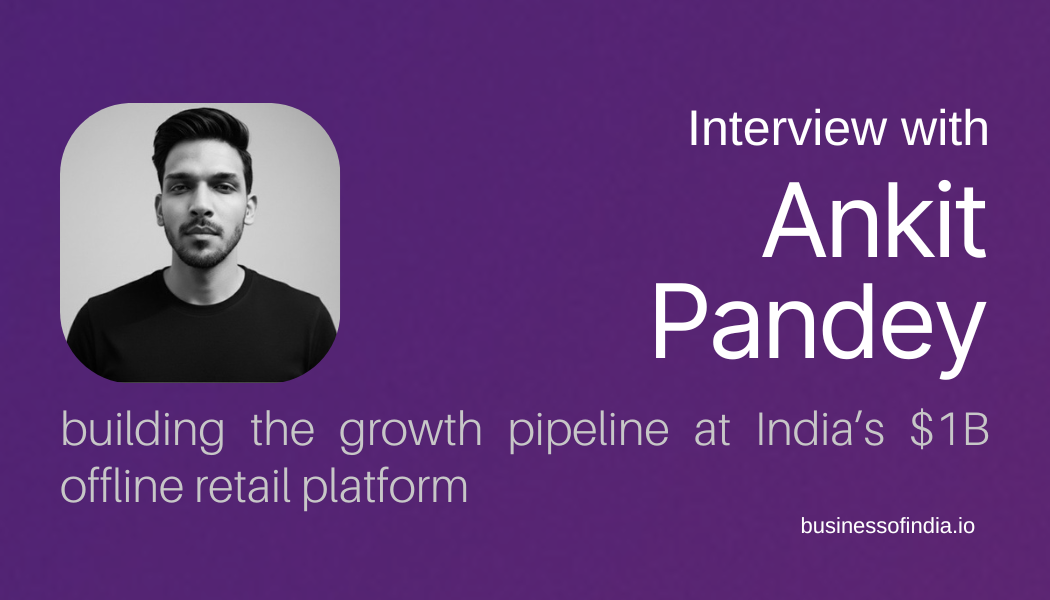
Ankit Pandey had a very unconventional start in the corporate world.
While many were collecting degrees and credentials, he opted to dive in headfirst and learn by getting his hands dirty. So his journey began with brewing coffee on the floor of a Starbucks store in the Mumbai suburb of Lokhandwala.
Today, Ankit builds partnerships and growth at magicpin, India's largest platform for offline retail which drives $1B+ in annual business to vendors across the country.
BOIn: You've described your education as coming from the "school of life", built through doing, failing, and figuring things out practically rather than through a conventional business school degree. That's a choice that requires a certain amount of confidence, or at least a willingness to bet on yourself early. What did that actually feel like at the start, when most people around you were following the more traditional route?
AP: At the beginning, honestly, it felt slightly uncomfortable because almost everyone around me was following a very defined roadmap, the college placements, MBAs, consulting tracks and structured career ladders. Meanwhile, there I was trying to build confidence through practical experience working on the ground rather than through credentials.
But over time, I realised that the market rewards people who can solve real problems consistently.
A classroom can teach frameworks, which are valuable, but there’s a different kind of learning that only happens when you’re dealing with actual customers, rejection, targets, negotiations, chaos, uncertainty, and figuring things out in real time. A lot of my education came from observation. Watching how people behave, why businesses grow, why customers trust certain brands, and why some conversations convert while others don’t. I learned by failing publicly, improvising often and staying curious enough to keep improving.
I think betting on yourself early forces you to become resourceful very quickly. You stop waiting to “feel ready” and start learning in motion.
BOIn: Absolutely true, Ankit, those early bets definitely make all the difference down the line. For you, one of those formative experiences started with joining the operations function at Starbucks India.
You've spoken about your time at Starbucks with a lot of warmth, noting it as the place where you unknowingly got your first real sales training when you had to repeat a coffee tasting pitch over 200 times. What specifically did that experience teach you about selling that you don't believe most classrooms ever explore?
AP: Starbucks taught me that selling is much more about energy, repetition and emotional understanding than people realise. When you repeat the same coffee tasting pitch hundreds of times, you learn tone. Timing. Reading body language. Adjusting your pitch within seconds depending on the person standing in front of you.
You also start noticing something interesting, which is that people rarely buy only because of information. They buy because of how you make them feel in that interaction. Most classrooms teach selling like it’s persuasion. Real-world selling teaches you that it’s actually trust building. Customers can instantly sense whether you genuinely believe in what you’re talking about or whether you’re mechanically delivering a script.
Starbucks also taught me discipline in consistency. Doing something well once is easy. Doing it well for the 200th time with the same enthusiasm is much harder, and that’s where professionalism begins.
BOIn: Moving on to your current work at magicpin, which is built on this genuinely interesting premise that offline retail, you know, the kirana stores, local restaurants, neighbourhood fashion outlets, don't have to lose to e-commerce. They just need to be connected to digital demand differently. After spending over four years inside that mission, what have you learned about what it actually takes to make that vision work, beyond the product itself?
AP: The biggest lesson is that technology alone does not transform offline retail. Behaviour does. India’s offline ecosystem is incredibly relationship-driven. A neighbourhood restaurant owner or fashion retailer is not just evaluating your product, they’re evaluating whether they trust you, whether you understand their business realities and whether your solution actually improves revenue in a meaningful way.
Over the years at magicpin, I realised that adoption happens when digital solutions feel practical, not futuristic.
Offline merchants don’t care about buzzwords. They care about footfall, repeat customers, inventory movement, margins, visibility, and whether business is better this month than last month.
So a huge part of making the vision work is operational execution at scale, onboarding, merchant education, retention, campaign alignment, account management, and constant experimentation. Yes, the product matters, but the ecosystem around the product is equally important. That is because India’s retail economy is fragmented, emotional, highly localised and incredibly resilient. You cannot build for it from a distance.
BOIn: That is very well put, Ankit. I especially like your sentiment on the diversity of India's retail sector, as many people tend to assume it is one uniform market that behaves the same universally. That point on localisation actually brings me to my next question.
You started out at magicpin cold-calling and onboarding local restaurants and have since moved through account management for regional brands and enterprise accounts to where your work now focuses on partnerships and growth. That's an extraordinary depth of exposure within a single company.
First of all, what did each of those transitions reveal to you about how a business like magicpin actually operates? How has this momentum shaped your perspective of the retail industry?
AP: Each transition gave me a completely different lens into how businesses operate. When I was cold-calling and onboarding restaurants initially, I learned resilience very quickly. You understand rejection, urgency, merchant psychology, and the importance of first impressions.
Then, account management taught me that signing a client is only the beginning. Retention and growth come from consistency, responsiveness and genuinely understanding the business beyond the dashboard metrics. Once I started working with regional brands, I got exposed to the real complexity of Indian retail. Every city behaves differently. Consumer preferences differ massively. What works in Bangalore may not work in Delhi or Lucknow.
As for enterprise partnerships, that changed how I thought about scale. Large brands require alignment across multiple teams, long-term thinking, structured execution and the ability to balance strategy with operational detail.
Overall, the journey made me realise that retail is not dying, it’s evolving.
The strongest offline businesses are the ones learning how to combine physical trust with digital discovery and convenience.
BOIn: Focusing on the enterprise partnerships you worked on, you've built monetisation initiatives from scratch and helped drive 2-4X growth for enterprise accounts within a year. Growth at that scale doesn't typically happen due to a single decision. It is more likely to be the result of a series of small bets and experiments.
What does that process actually look like for you? How do you decide what to test, and how do you know when something is worth doubling down on?
AP: I agree with you wholeheartedly. Most growth is the result of many small observations stacked over time.
The process usually starts with identifying friction points. Where are users dropping off? Where are merchants underutilising something? What behaviour is repeatable? What campaign performed unexpectedly well? What assumption are we making that may not actually be true?
From there, I like running controlled experiments rather than giant bets. Small pilots. Different positioning. Different incentives. Different communication styles. Different merchant categories. The key is staying close to ground reality instead of relying only on reports. A lot of successful growth initiatives happen because someone noticed a small behavioural insight early and acted on it consistently. And when something starts showing signals of stronger engagement, higher retention, better economics, repeatability across categories, that’s when you double down aggressively.
I’ve learned that growth is less about one breakthrough idea and more about developing strong feedback loops.
BOIn: Now, let's talk about some of your personal accolades. You've won three MVP awards during your time at magicpin, which in a company that size means you are consistently being recognised as someone who is raising the bar for standards and pushing results even beyond what is established as a baseline.
What do you think separates the people who grow quickly inside a company from those who plateau, and is it something that can be learned, or is it more a disposition?
AP: I think the biggest differentiator is ownership.
The people who grow fastest inside organisations are usually the ones who stop thinking, “This is my job description,” and start thinking, “How do I solve this problem regardless of whether it’s officially mine?” Curiosity also matters a lot. The willingness to ask questions, understand adjacent functions, learn commercial thinking and stay adaptable. Then there’s consistency. Many people work hard occasionally. Fewer people operate with reliability over long periods.
Generally, I don’t think rapid growth is purely talent-based. A large part of it can absolutely be learned, especially communication, accountability, problem-solving and business thinking. But I do believe there’s a certain disposition required, like comfort with ambiguity, willingness to take initiative and the ability to stay calm under pressure.
BOIn: So Ankit, you've worked at the intersection of large global enterprises like Domino's and KFC, and smaller regional brands like Om Sweets and Leon Grill, helping both grow on the same platform. Those are very different kinds of businesses with very different needs. What does that contrast reveal about what it actually takes to build something that works for Indian retail specifically, both from a home?
AP: The contrast is fascinating because both ends of the spectrum are solving for very different realities. Large enterprises operate with structure, process, scale, and data-driven decision-making. Regional brands often operate with instinct, speed, relationships and deep local understanding.
Honestly, India needs both.
Working across both categories made me realise that successful retail products in India cannot be designed only for the top 1% of organised businesses. They have to work in environments that are messy, fast-moving, multilingual, price-sensitive and operationally diverse.
India is not one market. It’s many parallel markets operating simultaneously.
The businesses that will win here are the ones that simplify complexity rather than importing global assumptions blindly.
BOIn: India has one of the largest offline retail economies in the world, with millions of small traders, local restaurants, and neighbourhood businesses that form the backbone of commerce in most cities and towns. But the mainstream coverage story of successful Indian business is almost always about the big tech platforms and the VC-backed startups.
What more do you believe needs to be done to close that storytelling gap? How can the grassroots and mid-scale ventures get more attention?
AP: I think India massively underestimates the importance of grassroots entrepreneurship stories. Some of the most resilient and economically important businesses in this country are local restaurants, traders, manufacturers, distributors, regional chains and family-run ventures that employ thousands of people and survive across generations, yet they rarely become part of mainstream business storytelling.
The startup ecosystem has understandably attracted attention because it represents innovation and scale. But there’s also incredible innovation happening in smaller cities and offline businesses that often goes undocumented.
We need more platforms, media houses, creators and investors paying attention to operational businesses, not just venture-funded narratives.
Because the truth is, India’s economy is not built only in boardrooms and tech parks. It’s built every day in markets, kitchens, warehouses, local stores and neighbourhood businesses run by people solving practical problems with limited resources.
Those stories deserve visibility too.