How to (actually) fix India's Learning problem

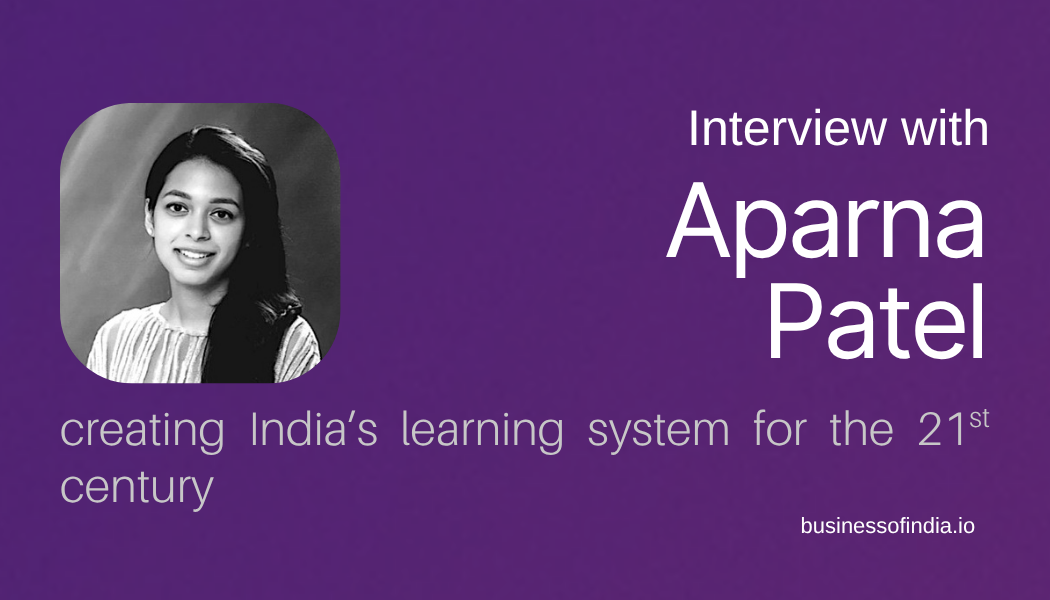
In 2018, Aparna Patel graduated with a Bachelor's in Psychology from the Pandit Deendayal Energy University in the state of Gujarat.
Her entry into the other side of the learning world would then arrive in October 2021, when she joined a new-age children's school in Delhi as a Content Lead. From there, her career expanded rapidly, going from a four-year faculty run at Rishihood University to designing and facilitating workshops for international organisations like KAOSPILOT and Art of Living.
In May 2026, she finally made the entrepreneurial jump to create AlignEd, where she is now helping education businesses to create scalable synergy between their marketing and pedagogy.
BOIn: AlignEd was recently founded in May 2026, and you've described the problem it's trying to solve as a design problem: education products that are good but invisible to the market, and products that market well but don't deliver.
What made you decide that now was the right moment to build something around that gap, and why, as a company, rather than as consulting work you were already doing?
AP: Honestly, the timing chose me more than I chose it.
I've been sitting with this problem for a while, first as a psychology researcher, then working inside an education institution, then consulting with education businesses on the side. And the pattern was the same everywhere.
Programs, courses and workshops that genuinely cared about what they were building but had no coherent way of expressing it. Or programs that had completely mastered the language of good education: experiential, holistic, student-led, but hadn't done the harder work of actually building it.
At some point, I realised I kept walking into the same room with different furniture.
What pushed me to make it a company rather than keep it as consulting is that consulting lets you solve the problem one client at a time. But this is a structural problem: marketing and pedagogy in most education businesses are completely siloed. Different people, different timelines, never made to talk to each other. That's not a gap you plug once. That's a design failure that needs dedicated practice.
On top of that, the stakes right now are higher than ever. There's been an explosion of education products in India. Be it tutoring, enrichment, or alternative schooling. Parents are more discerning, and honestly, more burned. They've been through enough "transformative experiences" to have developed a very sharp radar for when something doesn't add up. Trust, once lost, doesn't really come back.
So the combination of this pattern being everywhere, and the cost of ignoring it being higher than before is what made now feel like the right moment to stop doing this quietly and build something real around it.
BOIn: That's a really solid way to view the timing, Aparna, and your work at Rishihood must give you a real window into what AlignEd is trying to solve. You designed the Leadership Lab, an experience-driven course for teenagers, from the curriculum to the branding to the marketing communication. When you're working on something like that, that is so layered, where do you actually start? What's the first question you ask?
AP: For any program or course, I always start with the same question:
What do I want someone to feel and be prepared for when they walk out?
Not what they should know. Not what skills they'll gain. What's the emotional residue of the experience? Everything else: the curriculum, the sessions, the branding, the copy, is just working backwards from that answer.
With Leadership Lab, once I knew the feeling I was designing towards, the structure became obvious. And when it came time to write the marketing, I wasn't starting from scratch. I was just translating the same truth into a different language. That's alignment. It starts with one honest question.
BOIn: You also contributed to projects like the Indic Summer School at Pluskul as well as Anvesha and the Leadership Colloquium at Rishihood University, each with very different audiences, formats, and purposes.
What have those projects taught you about the difference between a learning experience that is designed well on paper and one that actually has impact with the people it's meant for?
AP: Paper designs are logical. Real experiences are emotional.
Every single one of those projects taught me that the gap between the two lives is in assumptions. You can assume that the audience shares your reference points. You can assume that the format will feel natural to them. You can assume engagement will follow good content. It won't.
What actually creates impact is when people feel seen by the experience, like it was made for them, not just at them. Learner-centric designing is essential. That only happens when you've spent more time listening before designing than designing itself.
BOIn: Learner-centricity is definitely very important, and it seems to be missing at the core of many experiences these days, but we will get back to that. I am a bit more curious about your personal trajectory.
You're the social media lead for L&D Shakers, an Amsterdam-based international community of learning and development professionals, while simultaneously building AlignEd, facilitating Art of Living programs across India, and teaching group sessions of Sudarshan Kriya (SKY breathwork). How do you hold that range? Is it designed in the service of personal curiosity and depth, or do these activities all feed one another in your perspective?
AP: Honestly, it doesn't feel like range to me. It feels like the same question asked in different rooms.
I'm multipassionate by nature, and I've stopped apologising for that. What I've realised is that I don't collect experiences randomly. I curate them consciously. Every single thing I'm part of has to mean something, feed something, or stretch something in me. Seva (unconditional service) is a big undercurrent in all of it. The breathwork, the facilitation, the community work, none of it is transactional.
And there's a synchronicity to it that I've learned to trust. Teaching SKY (Sudarshan Kriya Yoga) through the Art of Living organisation especially humbles me and gives me a spiritual conscience.
So yes, they all feed each other. That's not accidental. That's the whole point.
BOIn: Hmmm, that is so profound, Aparna.
On that note of personal and professional philosophy, you've argued, quite pointedly, that India's best teachers are not its most credentialed ones, that ‘jugaad’, the ability to improvise and adapt in real time, is itself a pedagogy. That's a direct challenge to how teaching excellence is measured and rewarded in Indian institutions.
What do you believe it would actually take to change that, not in theory, but in practice?
AP: I believe it starts with changing what we document.
Right now, institutions reward what's measurable: degrees, publications, and structured lesson plans. But the teacher who reads the room and pivots mid-session, who makes a concept land through a completely unexpected analogy, that's invisible in any appraisal system.
In practice, change looks like peer observation cultures, student feedback that actually matters, and space for teachers to reflect on their own facilitation.
Jugaad isn't the absence of design. It's design that's alive. We just need systems that can see it.
BOIn: There's a growing industry of EdTech in India that is well-funded, highly marketed, and often built on the assumption that better delivery of content is the problem. From where you sit, as someone working on learning design specifically, what do you think most EdTech companies are still getting wrong, and what would it look like to get it right?
AP: Most EdTech is solving a distribution problem and calling it a learning problem. Better video production, faster content delivery, slicker interfaces, none of that touches the actual question: did something shift in the learner? That's a design problem, not a technology problem.
What they're missing is the human in the loop. Learning is relational. It happens in the friction, the confusion, the moment a facilitator notices someone is lost and does something about it. Getting it right means building technology that serves the experience, not replaces it.
BOIn: Finally, Aparna, you're working at a moment when India is positioned at a unique point in global narratives; as a knowledge economy, as a global talent exporter, as a place building world-class institutions. From the inside of that work, what do you think the gap is between the story being told and the reality on the ground in classrooms and learning spaces across the country? And what gives you hope that the gap can close?
AP: The story being told is about scale. The reality on the ground is about depth, and we're not there yet.
With the current system, we produce more graduates than thinkers. Certificates, not capabilities. And the classroom experience for most students in this country still rewards compliance over curiosity.
What makes this particularly poignant is that India didn't start here. Nalanda, Takshashila, and the Gurukul system were learning ecosystems that the world traveled to. Deeply relational, inquiry-driven, built around the whole person.
Colonialism didn't just extract resources; it extracted our educational imagination and replaced it with factories for producing clerks.
NEP 2020 feels like the first serious attempt to remember what we actually knew. It's still a work in progress, but the intent to move towards experiential, multidisciplinary, rooted learning is the right direction.
What gives me hope is the people I meet who are quietly building differently. Teachers are improvising brilliantly with nothing. Founders creating programs that genuinely transform. Young people who are hungry in a way that no curriculum fully contains.
India has always figured things out from the inside. That instinct isn't gone. We're just finding our way back to it.